
⚡ Quick Answer
Wikipedia’s notability requirement means a subject must have received significant coverage in reliable sources that are independent of the subject. For founders and executives, this means three to five substantial journalist-authored features in recognized national or major industry publications — completely independent of anything your team arranged or paid for. Notability is not about how successful you are, how large your company is, or how many followers you have. It is about what independent journalists have chosen to document about you on their own editorial judgment.
Before you take a single step toward getting a Wikipedia page before you draft a single sentence, create a Wikipedia account, or contact a Wikipedia service you need to understand one concept completely: notability.
Notability is the single standard that determines whether your Wikipedia page will be approved or rejected. It exists outside your article. It cannot be fixed by better writing. It cannot be compensated for by stronger formatting or more careful citation. If you do not meet it, no version of your article will survive Wikipedia’s review process.
This guide explains exactly what the notability requirement means, how it applies specifically to founders and executives, how to assess your own eligibility honestly, and what to do if you do not qualify yet.
What Wikipedia Notability Actually Means
Wikipedia is an encyclopedia not a business directory, not a PR platform, and not a place to document your accomplishments on your own terms. Its entire purpose is to summarize human knowledge that has already been documented by independent, reliable sources. This purpose shapes every editorial decision Wikipedia’s volunteer community makes.
Notability is Wikipedia’s formal standard for determining whether a subject deserves a standalone article. A subject is considered notable if it has attracted enough independent, reliable documentation that an encyclopedia entry would serve a reader’s genuine interest in knowledge rather than serve the subject’s interest in promotion.
The critical distinction that most people miss is this: notability is not about merit, achievement, or importance in the real world. A founder who has built a billion-dollar company may not be notable by Wikipedia’s standard if that achievement has not been documented by independent journalists. A relatively unknown academic may be highly notable by Wikipedia’s standard because their work has been extensively covered in peer-reviewed journals and mainstream publications.
Wikipedia does not evaluate how successful you are. It evaluates how extensively and independently your success has been documented.
This distinction changes everything about how you should approach the question of whether you qualify.
The Three Parts of the Notability Standard
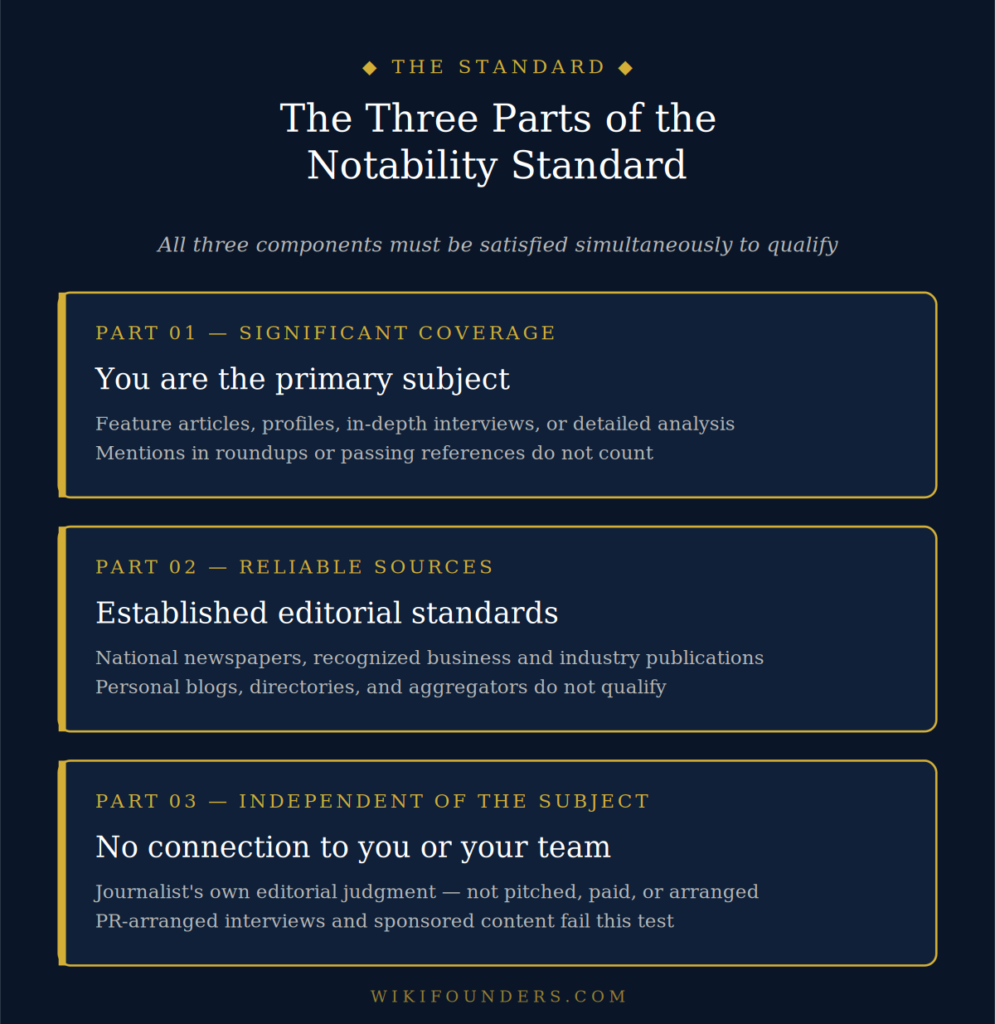
Wikipedia’s general notability guideline is deceptively simple. A subject is notable if it has received significant coverage in reliable sources that are independent of the subject. Every word in that definition carries specific meaning, and all three components must be satisfied simultaneously.
Significant coverage. Significant does not mean mentioned. It does not mean listed alongside other names in an industry roundup. Significant coverage means the source devoted substantial space to the subject as its primary focus a feature article, a profile, an in-depth interview that was independently initiated, or a detailed analysis of the subject’s work or impact. A passing reference in an article about something else does not count. A sentence mentioning your name in a list of industry players does not count. The coverage must be substantive, detailed, and focused on you or your company as the primary subject.
Reliable sources. Reliable means the source has an established editorial process, a track record of accuracy, and independent fact-checking standards. National newspapers, recognized business publications, major industry outlets, academic journals, and established broadcast media meet this standard. Personal blogs, industry directories, niche newsletters without established editorial standards, and any source primarily known for aggregating press releases do not. Wikipedia maintains a list of commonly cited sources and their reliability status experienced editors know this list and apply it immediately when reviewing citations.
Independent of the subject. Independent means the source has no connection to you financial, professional, or personal. This is the requirement that eliminates the most commonly submitted sources. An article your PR firm pitched does not count. Coverage you paid for in any form does not count. An interview your team arranged and facilitated does not count. A profile written by someone who works for your company or has a business relationship with you does not count. The source must have covered you entirely on its own editorial judgment, with no involvement from your side in initiating, shaping, or funding the coverage.
All three components must be present in each qualifying source. A detailed, reliable article that was arranged by your PR team fails the independence requirement. An independent, reliable publication that mentions you briefly fails the significance requirement. A detailed, independent feature in a personal blog fails the reliability requirement. Only coverage that satisfies all three simultaneously qualifies.
What Sources Count and What Do Not
This is where most Wikipedia submissions fail not because the submitter lacks genuine coverage, but because they are counting sources that Wikipedia editors will immediately recognize as non-qualifying.
Sources that count toward notability:
National newspapers with established editorial standards the Financial Times, the Wall Street Journal, the New York Times, the Guardian, major regional papers with national reach. Recognized business publications Forbes, Bloomberg Businessweek, Inc. Magazine, Fast Company, Wired provided the coverage is editorial rather than paid. Major industry publications with genuine editorial standards and a track record of independent journalism. Academic journals with peer-review processes. Recognized broadcast outlets BBC, CNN, major national television networks. Books published by recognized publishers and independently reviewed in credible media.
Sources that do not count toward notability:
Press releases of any kind including press releases republished by wire services or syndicated across hundreds of outlets. Every one of those republications counts as a single non-independent source, not hundreds of independent ones. Sponsored content, advertorials, or any coverage your team paid for in any form. Company blogs, founder newsletters, personal websites, and any source you own or control. Interviews that your PR team arranged, even if published in a credible outlet if your team initiated the coverage, it does not qualify. Social media posts, LinkedIn articles, and any self-published content regardless of the size of your following. Industry directory listings, award announcements from organizations that sell award recognition, and “best of” lists from sources that charge for inclusion.
The most common source confusion:
Many founders count press release pickups the dozens or hundreds of outlets that republish a press release verbatim as multiple independent sources. They are not. They are a single non-independent source republished many times, and experienced Wikipedia editors recognize this pattern immediately.
Many founders also count Forbes contributor articles, which are written by independent contributors on Forbes’ contributor network and not by Forbes’ editorial staff. These are treated differently by Wikipedia editors than staff-written Forbes editorial coverage. The distinction matters and is worth understanding before building your citation foundation.
Wikipedia Notability for Founders and Executives
The notability standard applies to people including founders, executives, authors, public figures, and academics through the same general framework, but the practical benchmark for what qualifies varies significantly by category.
For founders and executives, the practical minimum is:
Three to five substantial, independently initiated journalist-authored features about you specifically as the primary subject of the article published in recognized national or major industry publications, with no involvement from you or your team in initiating the coverage.
These features must be substantive. A 200-word profile in a regional business journal does not carry the same weight as a 1,500-word feature in a national outlet. A roundup article listing you among ten other executives does not qualify at all you must be the primary subject.
Categories of founders and executives who typically qualify:
Founders and CEOs who have been the subject of independent profiles in recognized national publications. Executives who have been covered in depth in connection with significant company milestones IPOs, major acquisitions, significant funding rounds where the coverage is about them specifically rather than just the transaction. Recipients of major industry awards that have been independently reported in credible media as news events. Authors of books published by recognized publishers that have been independently reviewed in credible publications. Academics and researchers whose work has been covered in both academic journals and mainstream media independently.
Categories that typically do not qualify yet:
Founders whose coverage consists entirely of press releases and the coverage those press releases generated. Executives who appear in roundup articles but have never been the primary subject of an independent feature. Founders of early-stage companies whose coverage is primarily local, regional, or trade-specific without national reach. Anyone whose most significant coverage came from content they or their team initiated, arranged, or paid for.
The founder-specific question to ask yourself:
Would a national journalist have written about me if my PR team had never reached out? If the honest answer is yes because your company has done something genuinely newsworthy, because your perspective is cited as an industry authority, because your story has been independently discovered and reported you likely have qualifying coverage. If the honest answer is no because every article in your portfolio traces back to a press release your team issued or a pitch your PR firm made you likely do not.
Wikipedia Notability for Companies and Businesses
Companies are evaluated under the same general notability framework as individuals, but Wikipedia also provides specific notability criteria for organizations that offer an additional path to qualification.
Path 1 Subject-specific criteria for organizations: A company meets Wikipedia’s notability standard if it appears in a major recognized industry ranking the Forbes Global 2000, the Fortune 500, the Inc. 5000 as a standalone entry, or an equivalent recognized ranking in its specific industry. Inclusion in these rankings does not automatically guarantee a Wikipedia page will be approved, but it establishes a baseline of documented significance that editors recognize.
Path 2 General notability criteria for organizations: A company qualifies through the general standard if it has received at least two substantial, independently written features in recognized national or generalist media that are focused specifically on the company, long enough to constitute genuine coverage, written on the outlet’s own editorial initiative rather than in response to a press release or PR outreach, and published at a meaningful interval rather than simultaneously as part of a single PR campaign.
The company-specific source problem: Many companies have extensive media coverage that was generated by their own PR activity press releases about funding rounds, product launches, and executive hires that were picked up by tech blogs, trade publications, and business wire services. This coverage, while valuable for brand awareness, does not count toward Wikipedia notability. Wikipedia editors are experienced at identifying coverage that traces back to a company’s PR activity, and they discount it entirely.
The practical benchmark for companies: Independent, journalist-initiated coverage in outlets that cover your industry at a national level, focused on your company as the primary subject, published across a meaningful time period, and not traceable to your own PR campaigns. Three such pieces from credible national publications is a reasonable minimum for most industries.
Notability for People vs Notability for Companies The Key Differences
This distinction matters significantly for founders who are considering both a personal Wikipedia page and a company Wikipedia page which is an increasingly common goal.
The primary difference is how independence is assessed. For a person, independence is relatively straightforward the coverage must not have been arranged by the person or their team. For a company, independence is evaluated more carefully because companies have PR departments whose explicit function is to generate coverage. Wikipedia editors apply additional scrutiny to company coverage to distinguish between genuinely independent journalism and coverage that was initiated by the company’s PR activity.
Notability does not transfer between subject types. A founder’s personal notability does not make their company notable, and a company’s notability does not make its founder notable. Each subject must qualify independently. This is one of the most common misunderstandings WikiFounders encounters founders who assume that because their company has a Wikipedia page, they automatically qualify for a personal page, or vice versa.
The sequencing question: For most founders pursuing both a personal and a company Wikipedia page, the practical question is which subject currently has stronger independent notability evidence. Start with whichever is better supported by your current coverage, and build toward the second as the second subject’s coverage develops.
The Five-Question Self-Audit Framework
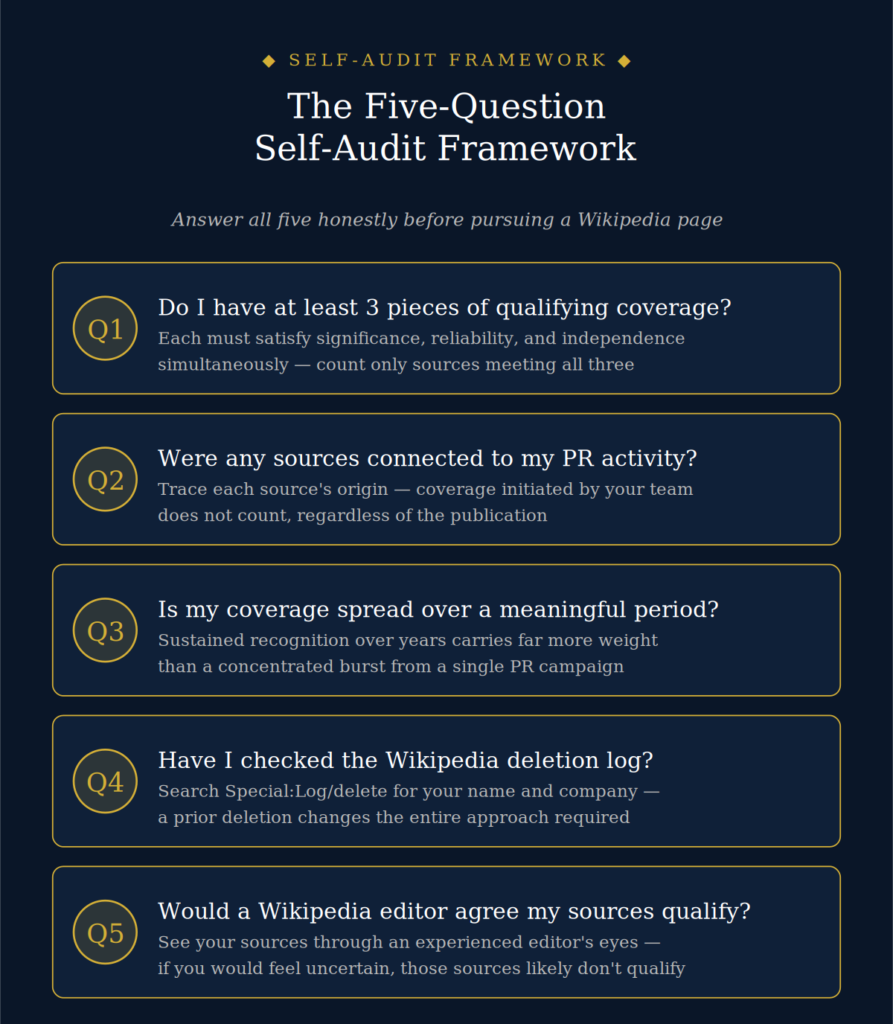
Before pursuing a Wikipedia page before contacting a service, before creating an account, before drafting a word work through these five questions honestly. They are designed to give you a clear, realistic picture of where you stand.
Question 1 Do I have at least three pieces of coverage that meet all three notability criteria simultaneously? For each piece of coverage you are considering, confirm it is significant (you are the primary subject, covered in depth), reliable (the source has established editorial standards and is not a blog, directory, or aggregator), and independent (no involvement from you or your team in initiating the coverage). Count only the pieces that satisfy all three. If you have fewer than three, you likely do not yet meet the standard.
Question 2 Were any of my qualifying sources connected to my PR activity? Go through your qualifying sources and trace the origin of each. Did a journalist independently discover your story, or did your team pitch it? Even if the resulting article is substantial and published in a credible outlet, coverage that was initiated by your PR team typically does not count toward notability. Remove any source where your team’s involvement was the reason the coverage exists.
Question 3 Is my coverage spread over a meaningful period of time? Three substantial independent features published over three years carry significantly more weight than three features published in the same month as part of a single PR campaign. Wikipedia editors look for coverage that reflects sustained, organic recognition rather than a concentrated burst of PR activity. If your qualifying coverage is clustered in a short window, this is worth noting before submission.
Question 4 Have I checked the Wikipedia deletion log for my name or my company’s name? Go to Wikipedia’s Special:Log/delete and search your name and your company’s name. If a prior deletion record exists, your path to a Wikipedia page is significantly different from a first-time submission and requires professional guidance before proceeding.
Question 5 Would a Wikipedia editor looking at my sources agree they qualify? This is the most important question and the hardest to answer honestly. Wikipedia editors are experienced at identifying the patterns of non-qualifying coverage press release pickups, PR-arranged interviews, sponsored content, and regional coverage that does not meet the national standard. Try to see your sources through an editor’s eyes rather than through your own. If you would feel uncertain presenting certain sources to an experienced Wikipedia editor, those sources probably do not qualify.
If you answered yes to all five questions you likely meet the standard. If you are uncertain about any of them a professional notability audit is the right next step before taking any further action.
Common Notability Mistakes Founders Make
These are the most frequent errors WikiFounders encounters when reviewing founders’ notability evidence for the first time.
Counting press release pickups as multiple sources. A press release that is republished by 200 outlets is a single non-independent source not 200 qualifying sources. This is the most common and most costly notability mistake. Many founders believe their extensive media presence qualifies them when virtually all of it traces back to their own PR activity.
Assuming Forbes contributor articles equal Forbes editorial coverage. Forbes operates a contributor network where independent writers publish under the Forbes brand but outside of Forbes’ editorial process. These articles are treated differently by Wikipedia editors than staff-written Forbes editorial content. The distinction is important and worth investigating before counting Forbes contributor coverage as qualifying evidence.
Counting regional coverage as national coverage. A substantial feature in a respected regional business journal is valuable coverage but it does not carry the same weight as national coverage and may not meet the standard on its own. Wikipedia editors apply judgement about the reach and recognized authority of publications.
Assuming industry awards establish notability. Awards from recognized organizations that are independently reported in credible media as newsworthy events can support notability. Awards purchased from organizations that sell recognition, or awards reported only in press releases, do not.
Submitting before confirming eligibility. The most expensive mistake a founder can make in the Wikipedia process is submitting a page before confirming they genuinely meet the notability standard. A failed submission creates a permanent deletion record that makes every future attempt harder. Confirming eligibility first through a professional audit if necessary is always the right investment.
How to Build Notability If You Do Not Qualify Yet
Not meeting Wikipedia’s notability standard right now is not a permanent condition. It is a starting point and understanding what you need to build is more valuable than attempting a premature submission.
Step 1 Identify exactly what you are missing. Use the self-audit framework above to assess your current coverage honestly. How many genuinely qualifying pieces do you have? What type of coverage are you missing national reach, independence, substantive depth? The answer determines what you need to build.
Step 2 Focus PR efforts on independent editorial coverage. The only coverage that builds Wikipedia notability is coverage that independent journalists choose to produce without your team’s involvement. This means positioning yourself as a source and expert not pitching stories about your company’s milestones. Journalists write about people and companies that help them tell interesting stories. Becoming a reliable, accessible, genuinely insightful source for journalists covering your industry is the most sustainable path to the kind of coverage that builds Wikipedia notability.
Step 3 Build over time, not in a single campaign. Coverage that accumulates organically over 12 to 24 months is significantly more credible to Wikipedia editors than a concentrated burst of PR activity. Sustainable notability building is a long-term effort not a campaign.
WikiFounders’ PR Citation Boost service sources new independent press coverage specifically designed to meet Wikipedia’s notability standard. For founders who do not yet qualify, it typically takes 3 to 6 months of focused coverage-building before a submission is ready. You can learn more about the complete process at wikifounders.com/how-to-get-a-wikipedia-page.
How WikiFounders Can Help
Every WikiFounders engagement begins with a free notability audit a professional assessment of your current eligibility that reviews your coverage, identifies qualifying and non-qualifying sources, and gives you a definitive answer about whether you meet the standard before any work or payment begins.
If you qualify now, the process moves directly to research, drafting, submission, and editorial management with a standard timeline of six to eight weeks to a live page.
If you do not yet qualify, WikiFounders tells you exactly what coverage you need and through the PR Citation Boost service actively works to build that coverage before submission. Most founders who are not yet eligible reach the threshold within 3 to 6 months of focused, targeted coverage-building.
View packages at wikifounders.com/pricing or book a free notability audit at wikifounders.com/contact.
Frequently Asked Questions
Wikipedia requires that a subject has received significant coverage in reliable sources that are independent of the subject. All three components must be satisfied simultaneously. The coverage must be substantive and focused on the subject, published in sources with established editorial standards, and completely independent of anything the subject or their team initiated or paid for.
Wikipedia does not specify a minimum number, but the practical benchmark for founders and executives is three to five substantial, independently initiated features in recognized national or major industry publications. Each source must satisfy all three components of the notability standard (significant coverage, reliability, and independence) simultaneously.
No. Press releases are not independent of the subject. They are produced by the subject’s team. Outlets that republish a press release verbatim do not count as independent sources regardless of how many republish it. A press release republished by 200 outlets counts as a single non-independent source, not 200 qualifying sources. Wikipedia editors recognize this pattern immediately.
No. Social media following, subscriber counts, and online popularity do not count toward Wikipedia notability under any circumstances. Notability is not the same as popularity. Wikipedia evaluates independent editorial documentation, not audience size, engagement metrics, or self-published content regardless of reach.
It depends on the type of Forbes article. Staff-written Forbes editorial coverage typically counts toward notability. Forbes contributor network articles (written by independent contributors outside Forbes’ editorial process) are treated with more scrutiny by Wikipedia editors and may not carry the same weight. Confirm whether the article was written by a Forbes staff journalist or a contributor before counting it as qualifying evidence.
Awards can support notability if they are from recognized organizations and have been independently reported as newsworthy events in credible media. Awards purchased from organizations that sell recognition, or awards reported only in press releases and award announcements, do not count. The award itself is not the notability evidence. The independent media coverage of the award is.
No. Notability does not transfer between subjects. A company’s Wikipedia page does not automatically qualify its founder for a personal Wikipedia page, and a founder’s personal page does not automatically qualify their company. Each subject must meet the notability standard independently through its own qualifying coverage.
Building the independent press coverage needed to meet Wikipedia’s notability standard typically takes 3 to 6 months of focused, consistent PR work. Coverage that accumulates organically over time carries more weight with Wikipedia editors than a concentrated burst of PR activity. WikiFounders’ PR Citation Boost service actively works to build qualifying coverage within this timeline.
Popularity is measured by audience size, engagement, and recognition within a community. Notability, as Wikipedia defines it, is measured exclusively by the extent and quality of independent editorial documentation in reliable sources. A person can be extremely popular with no Wikipedia notability, and relatively unknown in the general public while being highly notable by Wikipedia’s standard. The two concepts are completely unrelated.
Use the five-question self-audit framework in this guide to assess your coverage honestly. If you are uncertain after completing it, WikiFounders offers a free notability audit that gives you a definitive professional answer within 48 hours, reviewing your specific coverage against Wikipedia’s current editorial standards with no obligation to proceed with paid services.