
⚡ Quick Answer
A Wikipedia page for your business is one of the highest-authority credibility signals available in 2026 appearing first in Google for brand searches, feeding your Knowledge Panel, and serving as the primary source AI platforms cite when someone researches your company. Whether your business needs one depends on two things: whether you meet Wikipedia’s notability standard, and whether your goals are driven by public credibility. Most established businesses with independent national press coverage qualify and benefit significantly. Most early-stage companies should build their coverage first.
If you have ever searched a competitor’s company name and found their Wikipedia page sitting at the top of Google results above their own website you already understand the core argument for this guide.
A Wikipedia page for a business is not a vanity project. It is a permanent, third-party credibility signal that Google elevates above almost everything else, that AI platforms treat as an authoritative source, and that investors, journalists, and enterprise clients encounter before they encounter anything your own marketing team has produced.
This guide answers every question a founder or executive needs to answer before pursuing a Wikipedia page for their business including the questions most Wikipedia services do not want to address honestly.
What a Wikipedia Page Actually Does for Your Business
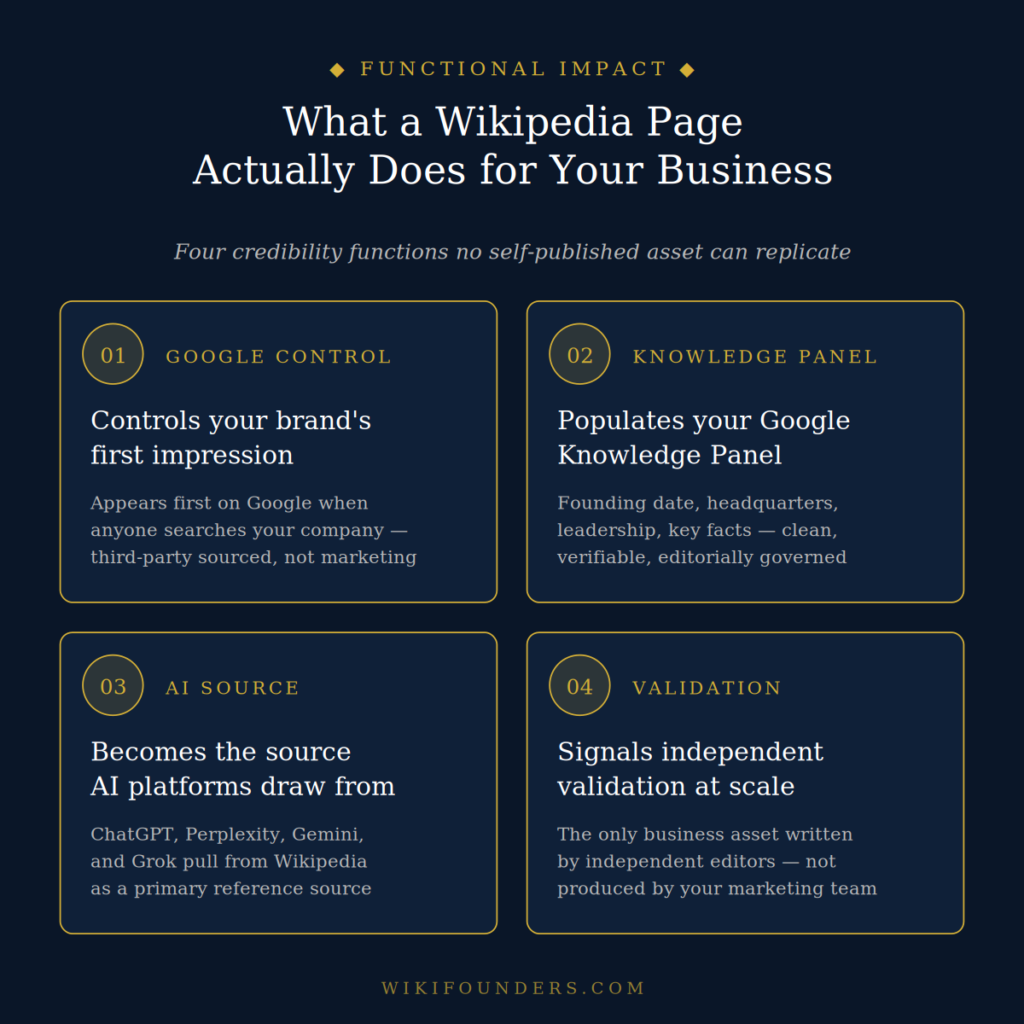
Most discussions about Wikipedia pages for businesses focus on what they look like. This guide focuses on what they do because the functional impact is what makes the investment worth understanding seriously.
It controls the first impression Google makes for your brand. When someone searches your company name, Google’s results are not within your control but the sources Google trusts most are predictable. Wikipedia is consistently one of the highest-authority domains on the internet, and a Wikipedia page about your company almost always appears on the first page of Google results for your brand name search. That means the first substantial thing an investor, journalist, or potential enterprise client reads about your company is written by independent third parties, sourced from verifiable publications, and governed by editorial standards not by your marketing team.
It populates your Google Knowledge Panel. The information box that appears on the right side of Google results for brand searches your company’s founding date, headquarters, leadership, industry, and key facts is populated primarily by Wikipedia. Without a Wikipedia page, that panel may be incomplete, absent, or filled with inaccurate data scraped from less reliable sources. With one, it is clean, verifiable, and under editorial governance.
It becomes the source AI platforms draw from. Every time someone asks ChatGPT, Perplexity, Gemini, or Grok about your company what it does, who founded it, what it has achieved those platforms pull from Wikipedia as a primary reference. An accurate, well-maintained Wikipedia page ensures that AI-generated descriptions of your business are correct. The absence of one means AI platforms will assemble their answers from whatever they can find which may be incomplete, outdated, or inaccurate in ways you have no visibility into.
It signals independent validation at scale. Every other asset your business has online your website, your LinkedIn page, your press releases was produced or initiated by your team. Wikipedia is the one asset that cannot be. Its content is governed by independent volunteer editors, sourced from third-party publications, and subject to ongoing community review. That independence is what gives it a credibility weight that no self-published asset can match.
Does Your Company Qualify The Honest Answer
This is the question most Wikipedia services avoid or answer vaguely. The honest answer requires understanding Wikipedia’s notability standard, which applies to businesses in a specific and documented way.
Wikipedia’s general notability guideline requires that a subject has received significant coverage in reliable sources that are independent of the subject. For businesses, this means the coverage must be in recognized publications with genuine editorial standards, must be about your company specifically, and must not have been initiated or paid for by your team.
Beyond the general standard, Wikipedia has specific notability criteria for organizations and companies. A business meets the notability standard if it appears in a major industry ranking such as the Forbes Global 2000 or the Fortune 500 or if it has received at least two substantial, independent features in recognized national or generalist media that are focused solely on the company, long enough to constitute genuine coverage, born of editorial judgment rather than interviews arranged by your PR team, and published at least two years apart.
What counts as qualifying coverage: National newspapers, major business publications, recognized broadcast outlets, and academic journals that covered your company independently. The coverage must be about your company as the primary subject not a roundup article that mentions you alongside nine other businesses.
What does not count: Press releases you issued, articles that republished your press release, sponsored content or paid media placements, industry directories, and interviews your PR firm arranged. Wikipedia editors are experienced at identifying these sources and they will not accept them.
The most important rule: Do not attempt to create a Wikipedia page before confirming you meet the notability standard. A failed submission creates a permanent deletion record that makes every future attempt harder. A professional notability audit which WikiFounders provides free of charge within 48 hours gives you a definitive answer before you take any action.
Who Genuinely Benefits from a Business Wikipedia Page
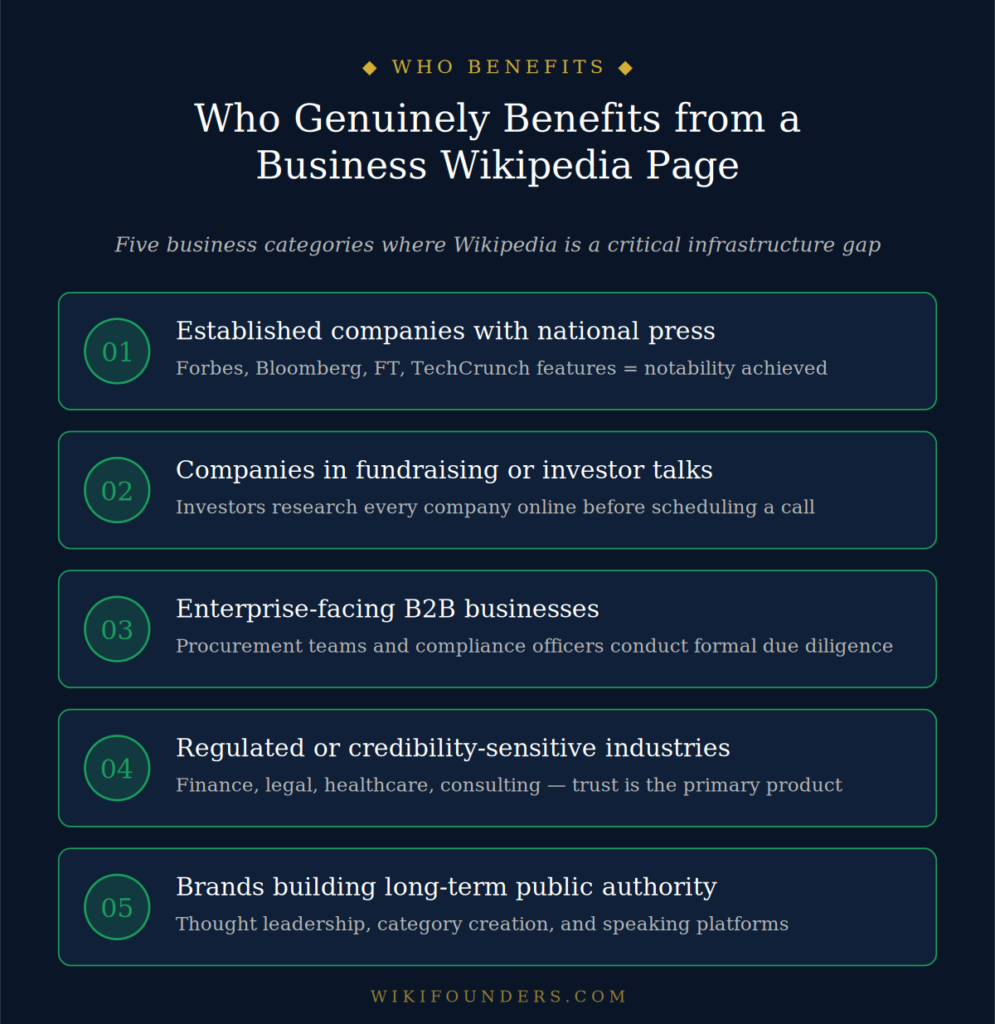
Not every business benefits equally from a Wikipedia page. For certain categories, it is not optional it is a gap in their digital infrastructure that costs them real opportunities.
Established companies with national press coverage. If your business has been featured independently in Forbes, Bloomberg, the Financial Times, TechCrunch, or comparable national publications, you likely already meet the notability standard. Not having a Wikipedia page at that stage means the coverage your business has earned is not being converted into a permanent, Google-first credibility anchor. Every month without a Wikipedia page is a month your brand’s first impression is being determined by whatever Google happens to rank above your site.
Companies actively in fundraising or investor conversations. Investors conduct online research before every meeting without exception. A company with a Wikipedia page signals something that a company website cannot: independent, third-party recognition from sources that had no incentive to write favorably. Several WikiFounders clients have reported that investors specifically mentioned finding their Wikipedia page as a credibility signal before scheduling a call. When you are asking someone to commit capital to your business, the absence of a Wikipedia page is a gap sophisticated investors notice.
Enterprise-facing B2B businesses. For companies whose sales cycles involve large enterprise clients, procurement teams, or compliance officers, the due diligence process is thorough and formal. A Wikipedia page appears in that research and adds a layer of institutional credibility that no self-published asset can replicate. In enterprise sales, trust is the primary product and Wikipedia is one of the few third-party signals that communicates trust before a single conversation has taken place.
Companies in regulated or credibility-sensitive industries. Finance, legal services, healthcare, consulting, and real estate are industries where clients and partners make significant decisions based on trust. A Wikipedia page in these industries is not just useful it is increasingly expected among serious operators.
Brands building long-term public authority. If your company’s strategy involves becoming a recognized authority in your space through thought leadership, speaking, media engagement, or category creation a Wikipedia page is the foundation that makes all of that work more credible. It anchors your brand in a way that other platforms cannot, because it is governed by standards your team cannot influence.
Who Should Wait
An honest guide requires acknowledging who should not pursue a Wikipedia page right now.
Early-stage companies with limited independent press coverage. If your company’s media coverage consists primarily of press releases, local news mentions, or coverage your PR team arranged, you almost certainly do not meet the notability standard yet. Attempting a submission anyway results in deletion and that deletion record makes every future attempt significantly harder. The right path is to build your independent media coverage first.
Businesses whose audience is entirely private. If your company operates in a space where clients are found through private networks, personal referrals, or closed channels and your potential clients are not conducting public online research a Wikipedia page may not move any meaningful needle for your business right now.
Startups at the pre-revenue or pre-press stage. Build the business first. Build the coverage next. The Wikipedia page will be there when you genuinely qualify for it and when the investment makes sense relative to your stage.
The AI and Google Argument for Businesses in 2026
The case for a business Wikipedia page has grown substantially stronger over the past two years not because Wikipedia has changed, but because the way information is consumed has changed fundamentally.
Google’s March 2026 Core Update, which completed rolling out on April 8, 2026, was one of the most volatile algorithm changes in recent history. Nearly 80 percent of top-three search results shifted positions. What the update explicitly rewarded was authoritative, editorially independent content with strong E-E-A-T signals. What it penalized was thin, self-published, or AI-generated content without genuine editorial backing.
Wikipedia by its nature satisfies every signal the March 2026 update rewards. It is written by independent editors, sourced from verifiable third-party publications, and maintained by a community governed by accuracy standards. In an environment where Google is actively redistributing visibility away from self-published content, Wikipedia is the one asset whose authority only strengthens over time.
The AI dimension is equally significant. When a procurement officer at an enterprise company asks their AI assistant about your business before a vendor meeting, that AI is drawing from Wikipedia as a primary reference. When an investor uses Perplexity to research your company before a first call, the summary they read is shaped by your Wikipedia page. When a journalist preparing a story about your industry searches Gemini for background on key players, your Wikipedia page determines whether your company is cited accurately, cited poorly, or not cited at all.
A business without a Wikipedia page in 2026 is ceding control of its AI-generated narrative to whatever sources happen to be available with no ability to influence accuracy, completeness, or framing.
Founder Page vs Company Page Which Comes First
This is one of the most common questions WikiFounders receives from founders who are considering Wikipedia for the first time and one that no competitor addresses directly.
The short answer is: it depends on where your notability currently lies.
In most cases, a founder’s individual notability and a company’s notability develop in parallel but at different speeds. A founder who has been featured extensively in national media as an individual profiled as a leader, recognized with industry awards, cited as an expert may have stronger personal notability than their company does. In that case, a founder Wikipedia page is the right first step, with a company page following once the business has accumulated sufficient independent coverage of its own.
In other cases, the company has more independent press coverage than the individual founder does particularly in sectors where coverage tends to focus on the organization rather than its leadership. In that case, the company page comes first.
The most important principle: both pages must meet the notability standard independently. A company page does not automatically confer notability on the founder, and a founder page does not automatically qualify the company. They are evaluated separately by Wikipedia editors, and both require their own independent sourcing.
Many WikiFounders clients pursue both a founder page and a company page as part of a coordinated authority-building strategy starting with whichever is better supported by current coverage, then building the second page as the second subject’s notability develops.
What a Business Wikipedia Page Cannot Do
Setting honest expectations is part of what separates a trustworthy guide from a sales document.
It will not replace a PR strategy. A Wikipedia page is the output of a strong PR strategy. Without independent press coverage meeting Wikipedia’s notability standard, there is no page to create.
It will not give your business control over its narrative. A Wikipedia page is editorially independent by definition. Your team cannot determine what goes on it, cannot remove information that is accurately sourced, and cannot use it as a marketing channel. The content reflects what independent sources have documented not what your brand wants to say about itself.
It will not directly generate leads or sales. A Wikipedia page is a credibility signal, not a conversion tool. Its value is in making every other touchpoint in your sales and marketing process more effective not in directly producing pipeline.
It will not compensate for weak notability. If your business has not earned genuine independent coverage, a Wikipedia page will either be rejected or deleted. There are no shortcuts through this requirement, and any service that suggests otherwise is misleading you.
The Risks of a Poorly Managed Wikipedia Page
A Wikipedia page that goes unmanaged after publication is not just a missed opportunity it is an active liability.
Vandalism is real and common. Any registered Wikipedia user can edit your company’s page at any time. Competitors, dissatisfied customers, or simply bad actors can add inaccurate information that remains on your page and in Google results for weeks without active monitoring.
Editorial challenges can arise at any time. Wikipedia editors may challenge the continued existence of your page if they believe notability standards are no longer adequately met. Without active management updating the page as your company evolves, adding new citations from recent coverage, responding to Talk page challenges pages that were approved cleanly can face deletion years later.
AI platforms inherit inaccurate information. An outdated or vandalized Wikipedia page does not just look bad in Google. It actively shapes how AI platforms describe your business to everyone who asks about it investors, journalists, clients, and partners until the inaccuracy is corrected.
WikiFounders provides monthly monitoring and vandalism protection as part of every ongoing plan, ensuring your page remains accurate long after publication.
How to Get a Wikipedia Page for Your Business
The process for getting a Wikipedia page for your business follows a clear sequence and the order matters.
Step 1 Confirm eligibility before doing anything else. Check Wikipedia’s public deletion log for any prior submissions under your company name. Then honestly assess whether your current press coverage meets the notability standard. A free notability audit from WikiFounders gives you a professional answer within 48 hours.
Step 2 Build your coverage if needed. If you do not yet qualify, focus on securing genuine independent media coverage in recognized national publications before attempting a submission. WikiFounders’ PR Citation Boost service sources new press citations specifically designed to meet Wikipedia’s notability standard.
Step 3 Draft in Wikipedia’s format. The article must be written in encyclopedic tone neutral, verifiable, and structured according to Wikipedia’s manual of style. Every claim must be attributed to an independent source. No promotional language. No marketing copy. No first-person voice.
Step 4 Submit through Articles for Creation. New articles go through Wikipedia’s Articles for Creation process, where experienced editors review the submission. The review takes 4 to 12 weeks. Editors may return the article with revision requests responding promptly and thoroughly to each round of feedback significantly improves approval rates.
Step 5 Monitor and maintain after publication. Set up monthly monitoring immediately after your page goes live. Update the page as your company grows and new coverage is published. Respond to editorial challenges on the Talk page promptly and professionally.
You can read our complete step-by-step guide at wikifounders.com/how-to-get-a-wikipedia-page.
How WikiFounders Can Help
WikiFounders specializes exclusively in Wikipedia page creation, monitoring, and maintenance for founders, executives, and businesses. This is not one service among twenty it is the only thing we do, which is why our results are consistently stronger than general digital agencies or freelancers who treat Wikipedia as a side project.
Every engagement begins with a free notability audit a professional assessment of your current eligibility before any work or payment begins. If you qualify, the process moves to research, drafting, submission, and editorial management with a standard timeline of six to eight weeks to a live page.
If you are not yet at the notability threshold, WikiFounders identifies exactly what coverage you need and, through the PR Citation Boost service, works to build that coverage before submission.
View packages at wikifounders.com/pricing or book a free notability audit at wikifounders.com/contact.
Frequently Asked Questions
If your business has received independent national press coverage, is actively fundraising, or operates in a credibility-driven industry, a Wikipedia page provides a meaningful, permanent advantage. If you are early-stage with limited independent media coverage, build your press presence first. A free notability audit from WikiFounders tells you within 48 hours whether you currently qualify.
A Wikipedia page appears first in Google for your brand name search, populates your Google Knowledge Panel with accurate information, and is cited as a primary source by AI platforms including ChatGPT, Perplexity, and Gemini. It is the only credibility signal your business can have that is written by independent third parties and governed by editorial standards, not produced by your team.
Your company qualifies if it appears in a major industry ranking like the Forbes Global 2000 or Fortune 500, or if it has at least two substantial independent features in recognized national publications focused specifically on your company. Press releases, sponsored content, and PR-arranged coverage do not count. WikiFounders’ free notability audit gives you a definitive professional answer within 48 hours.
Technically yes, but Wikipedia’s conflict of interest policy strongly discourages it, and self-created company pages have a very high deletion rate. More critically, a failed attempt creates a permanent deletion record that makes every future attempt significantly harder. Working with a specialized Wikipedia service for the initial submission is strongly recommended.
Start with whichever has stronger notability evidence right now. If you as a founder have more independent national coverage than your company does, pursue the founder page first. If your company has more documented independent coverage, start with the company page. Both must meet Wikipedia’s notability standard independently. One page does not automatically qualify the other.
For businesses that already meet the notability standard, the realistic timeline is 3 to 6 months from first step to a live page, with the Articles for Creation review alone taking 4 to 12 weeks. WikiFounders manages the full process in 6 to 8 weeks for qualifying clients. If your business does not yet qualify, add 3 to 6 months of coverage-building before submission.
A poorly managed Wikipedia page can become a liability. Because anyone can edit Wikipedia, pages without ongoing monitoring are vulnerable to vandalism, competitor edits, and the addition of negative information from independent sources. A well-managed page with monthly monitoring eliminates this risk and ensures your page remains accurate and authoritative long-term.
Yes, significantly. A Wikipedia page consistently appears on the first page of Google for brand name searches, feeds directly into Google’s Knowledge Panel, and following the March 2026 Core Update, benefits from Google’s increased weighting of editorially independent, high-authority content. It is the one result that holds its position through algorithm changes because of its domain authority and editorial standards.
WikiFounders packages start at $499 setup plus $99 per month for the Foundation plan, covering full research, writing, publication support, and basic monitoring. The Authority plan at $749 setup plus $149 per month includes enhanced sourcing, full monitoring, and two page edits per month. A free notability audit is included before any paid engagement begins.
A prior deletion creates a permanent record that every future editor will review. Resubmission requires substantially stronger notability evidence than the original attempt provided. Do not attempt a second submission without professional guidance. An unsuccessful second attempt under a deletion record can permanently close the door on future submissions. WikiFounders specializes in exactly this situation.