
⚡ Quick Answer
A rejected Wikipedia page is not the end — but it requires a specific response depending on why it was rejected and whether a permanent deletion record now exists. The most important thing to understand immediately: resubmitting without making meaningful changes is the worst possible next step. It triggers tendentious editing flags, damages your standing with reviewers, and can permanently close the door on future attempts. Read the rejection reason carefully, address the root cause completely, and only resubmit when the underlying problem is fully resolved.
You spent days or weeks building a Wikipedia submission. You gathered sources, drafted the article, formatted citations, and submitted through Articles for Creation. Then the notification arrived your Wikipedia page was rejected.
The frustration is real. So is the confusion about what to do next.
Most guides explain why Wikipedia rejects pages. This one goes further it explains exactly what each rejection reason means, what the deletion record does to your future chances, and the precise steps to take to recover. It is written specifically for founders and executives, not for general Wikipedia contributors.
Why Wikipedia Rejects Pages The Real Reason
Wikipedia is not a publishing platform, a business directory, or a PR channel. It is an encyclopedia governed by a specific set of editorial standards, enforced by approximately 910 volunteer editors who review new submissions in their spare time alongside managing the existing 6.7 million articles.
When your submission is rejected, it is not because Wikipedia is difficult or arbitrary. It is because the submission did not meet one or more of the specific standards those editors are trained and motivated to enforce. Understanding which standard you failed and why is the entire difference between a recoverable situation and a permanent problem.
The critical distinction that most guides miss is this: there are two fundamentally different types of rejection.
Type 1 A declined draft. Your article was reviewed and returned with feedback requesting changes. The draft still exists in your sandbox. This is a normal, recoverable part of the process. Many articles go through two or three rounds of revision before approval.
Type 2 A speedy deletion. Your article was deleted outright often within hours of submission because it violated a core Wikipedia policy seriously enough to warrant immediate removal rather than a revision request. This creates a permanent deletion record that every future editor will see.
The response to each type is fundamentally different. Type 1 requires careful revision and resubmission. Type 2 requires a completely different strategy and in many cases, professional guidance before any further action is taken.
The 7 Specific Rejection Reasons and How to Fix Each One
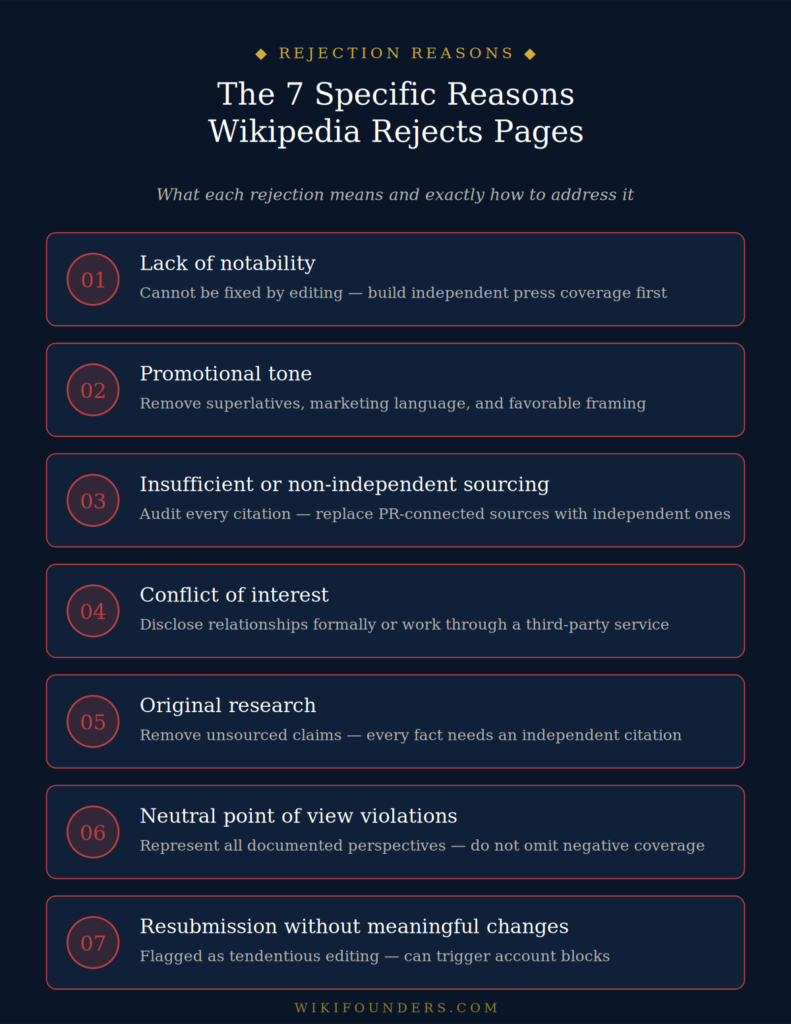
Wikipedia editors leave specific reasons when they decline or delete a submission. These are the seven most common ones what each means, what you did wrong, and exactly how to address it.
Reason 1 Lack of notability.
This is the most common rejection reason and the only one that cannot be fixed by editing the article itself. Notability is a standard that exists outside the article it is determined by whether the subject has received significant coverage in reliable, independent sources. If your coverage does not meet the standard, no amount of rewriting will change the outcome.
What to do: Do not resubmit. First, honestly assess whether your coverage genuinely meets Wikipedia’s notability standard three to five substantial, journalist-authored features in recognized national or major industry publications, completely independent of anything your team arranged or paid for. If you do not meet that standard, building your coverage is the only path forward. WikiFounders’ PR Citation Boost service sources new independent press coverage specifically designed to meet Wikipedia’s notability requirements.
Reason 2 Promotional tone.
Wikipedia articles must read like encyclopedia entries neutral, factual, and completely free of language that promotes, celebrates, or markets the subject. Phrases like “industry leader,” “innovative approach,” “award-winning,” or any superlative about the subject’s qualities are immediate red flags. So is any language that sounds like it belongs in a press release, a company website, or a marketing brochure.
What to do: Read the article as if you have never heard of the subject. Every sentence that sounds favorable rather than neutral needs to be rewritten. Remove all adjectives that describe quality, achievement, or reputation. Replace promotional claims with factual statements attributed to independent sources. A useful test: would this sentence appear in the Encyclopaedia Britannica? If not, rewrite it.
Reason 3 Insufficient or non-independent sourcing.
Every claim in a Wikipedia article must be attributed to a reliable, independent source. Wikipedia editors will review every citation for reliability and independence. Sources that fail include press releases, company blogs, sponsored content, articles that republished your press release, personal websites, social media, and any outlet your team paid or contacted to produce the coverage.
What to do: Audit every citation in your article. For each one, ask honestly: was this source completely independent of you and your team? Did a journalist write this without any involvement from your side? If the answer is no or uncertain, remove the citation and find a qualifying replacement. If your article cannot be adequately sourced without these citations, your notability evidence is insufficient and rebuilding your coverage is the required next step.
Reason 4 Conflict of interest.
Wikipedia requires that anyone with a personal, professional, or financial interest in the subject of an article disclose that relationship. This applies to founders creating articles about themselves, employees creating articles about their employer, and anyone who has been paid to create a Wikipedia article. Undisclosed paid editing is a serious violation that can result in account suspension in addition to article deletion.
What to do: If your rejection cited conflict of interest, disclose the relationship immediately on your user Talk page using Wikipedia’s standard disclosure language. For paid editing, use the formal paid editing disclosure template. Do not attempt to obscure or deny the relationship Wikipedia editors are experienced at identifying it. If you are a founder attempting to create your own Wikipedia page, transitioning to a third-party service like WikiFounders which discloses paid editing relationships in compliance with Wikipedia’s terms is the appropriate path.
Reason 5 Original research.
Wikipedia articles cannot contain information, analysis, or conclusions that are not already documented in published, independent sources. This means you cannot include facts about your business that have never been reported by an independent publication, draw conclusions that no source has explicitly drawn, or make claims that exist only on your own website or in your own materials.
What to do: Remove every claim that is not directly supported by a citation to an independent, published source. If a fact about your company has not been reported by an independent publication, it cannot appear in your Wikipedia article regardless of how accurate or significant it is.
Reason 6 Neutral point of view violations.
This is related to but distinct from promotional tone. A neutral point of view violation occurs when the article presents contested information as fact, omits significant negative coverage that independent sources have reported, or frames events in a way that serves the subject’s interests rather than presenting all documented perspectives fairly.
What to do: Review the article for any information that has been contested or reported negatively by independent sources. If negative coverage exists in credible independent publications, it must be represented fairly in the article. Attempting to create a Wikipedia page that omits documented criticism is a violation that experienced editors will catch quickly.
Reason 7 Resubmission without meaningful changes.
If your draft was previously declined and you resubmitted it without addressing the specific feedback from the reviewing editor, Wikipedia may flag this as tendentious editing a pattern of disruptive behavior that wastes editor time and demonstrates unwillingness to follow the community’s guidelines. This can result in account blocks in addition to article deletion.
What to do: Never resubmit a declined draft without making substantive changes that directly address every point of feedback from the previous review. If you are unsure what changes are required, ask at the Articles for Creation Help Desk before resubmitting. Document the changes you made so the reviewing editor can see clearly what was addressed.
The Deletion Record What It Means and Why It Matters Permanently
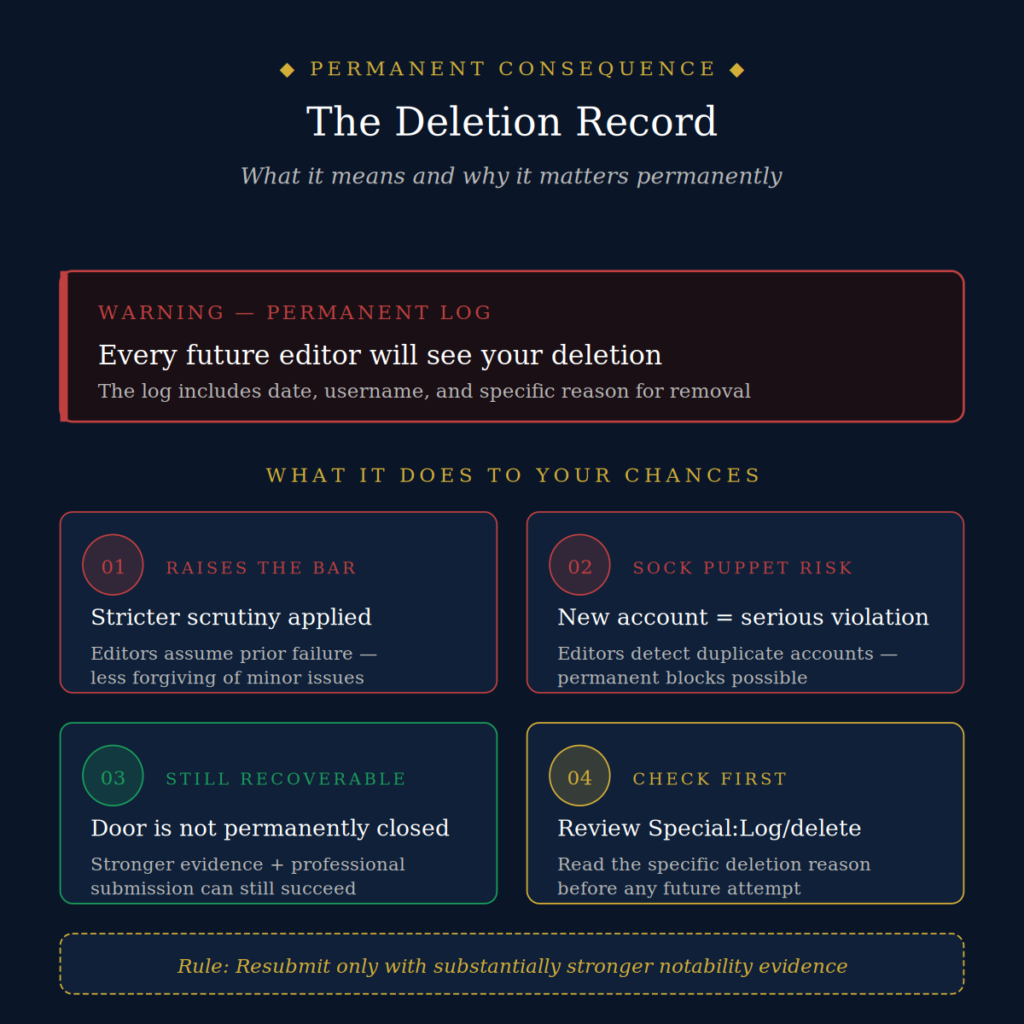
This is the section most Wikipedia guides skip entirely and it is the most important one for anyone who has received a speedy deletion rather than a simple decline.
When a Wikipedia article is speedily deleted, the deletion is logged permanently in Wikipedia’s public deletion records. This log entry includes the date of deletion, the username of the deleting editor, and critically the specific reason the article was removed. Every editor who reviews a future submission for the same subject will find this record immediately.
What the deletion record does to your future chances:
It raises the bar significantly for any future submission. An editor reviewing your second attempt will approach it with the assumption that the subject previously failed Wikipedia’s standards. They will scrutinize the notability evidence more carefully, examine the sourcing more rigorously, and be less forgiving of minor deficiencies that might be overlooked in a first submission.
The most dangerous mistake after a deletion:
Creating a new Wikipedia account and submitting a new article about the same subject, hoping the deletion record will not be found. Wikipedia editors are skilled at identifying sock puppet accounts multiple accounts operated by the same person to circumvent previous decisions. This is a serious violation that can result in permanent account blocks and makes future legitimate submissions exponentially harder.
What the deletion record does not mean:
It does not permanently close the door. A deletion record means the bar is higher not that the bar cannot be cleared. With substantially stronger notability evidence, a professionally drafted submission, and a proper third-party disclosure, a subject with a prior deletion can successfully obtain a Wikipedia page. But the approach must be fundamentally different from the original attempt.
Before attempting any second submission:
Check the deletion log at Wikipedia’s Special:Log/delete. Read the specific reason the editor gave for deletion. Assess honestly whether the root cause has been resolved. If notability was the issue, confirm that your coverage has materially improved since the deletion. If the issue was sourcing or tone, ensure the new draft has been completely rebuilt rather than lightly edited.
What to Do Immediately After Your Wikipedia Page Is Rejected
The first 48 hours after a rejection are the most important not because you should resubmit quickly, but because the decisions you make in this window determine whether you recover cleanly or compound the problem.
Step 1 Read the rejection notice completely and carefully. Wikipedia editors leave specific, detailed reasons for declines and deletions. Read every word. Do not skim for the main point the details matter. A rejection for “lack of notability” requires a completely different response than a rejection for “promotional tone,” even though both result in a declined article.
Step 2 Do not resubmit immediately. The instinct after rejection is to fix the obvious problems and resubmit as quickly as possible. Resist this completely. A hasty resubmission that does not fully address the root cause wastes your window with the reviewing editor and moves you closer to a tendentious editing flag. Take the time to fix the problem properly.
Step 3 Check the deletion log. Go to Wikipedia’s public deletion log and search your name or your company’s name. Confirm whether a permanent deletion record now exists. If it does, you are in a more serious situation than a standard decline and the appropriate response changes significantly.
Step 4 Assess your notability honestly. If the rejection cited notability, do not simply look for more sources. Assess whether your coverage genuinely meets the standard. Be honest. Press releases, sponsored content, and PR-arranged interviews do not count regardless of the publication they appear in. If your qualifying coverage is thin, rebuilding it before resubmitting is the only viable path.
Step 5 Decide whether to proceed independently or with professional help. If this is a first decline for a recoverable reason tone, sourcing format, minor structural issues you may be able to address it yourself. If the rejection cited notability, if a deletion record now exists, or if you have already attempted resubmission once, professional guidance is strongly recommended before any further action.
The Recovery Roadmap Step by Step
This is the structured path from a rejected Wikipedia page to a live, approved one for founders and executives who are committed to getting this right.
Phase 1 Diagnose before doing anything. Understand precisely why the rejection happened. Read the editor’s notes. Check the deletion log. Assess your notability evidence honestly. Do not move to Phase 2 until you have a clear, documented understanding of the root cause.
Phase 2 Address the root cause completely. If notability is the issue, build your coverage before resubmitting. This means securing genuine independent features in recognized national publications a process that typically takes 3 to 6 months of focused PR work. If the issue is tone or sourcing, rebuild the article from scratch using Wikipedia’s standards as the template rather than attempting to patch the original draft.
Phase 3 Rebuild the submission professionally. A rejected draft that is lightly edited is not a new submission it is the same failed article with minor changes. A proper resubmission requires a complete rebuild: new structure, fully reviewed sourcing, encyclopedic tone from the first word, and complete compliance with Wikipedia’s manual of style. If you are working with a professional service, this rebuild should be performed by someone with direct experience of what current editors are approving.
Phase 4 Disclose properly before submitting. If you have any connection to the subject founder, employee, paid contributor declare it explicitly before submitting. Use Wikipedia’s paid editing disclosure template if applicable. Attempting to conceal a relationship that editors will likely identify anyway damages your credibility and your article’s chances simultaneously.
Phase 5 Submit and respond to feedback promptly. When you resubmit, monitor the Talk page daily. Respond to every piece of editor feedback within 48 to 72 hours with thorough, well-considered revisions. Editors form impressions of submitters through their responsiveness and the quality of their revisions both matter to the outcome.
When to Stop Trying DIY and Get Professional Help
There is no shame in recognizing that the Wikipedia submission process requires expertise that most people including experienced writers and PR professionals simply do not have.
You should strongly consider professional help if:
Your submission has been rejected more than once. A deletion record now exists. The rejection cited notability and you are unsure whether your current coverage genuinely qualifies. You have resubmitted without making the changes the editor requested. Your article was flagged for conflict of interest. You are a founder attempting to create a page about yourself or your own company.
What professional help actually means in this context:
It does not mean paying someone to game Wikipedia’s system that approach fails and creates additional problems. It means working with a team that has deep, current familiarity with what Wikipedia editors are approving, how to build submissions that clear the review process cleanly, and how to manage the ongoing relationship with Wikipedia’s editorial community after publication.
WikiFounders specializes exclusively in Wikipedia page creation for founders and executives. Every engagement begins with a free notability audit that assesses your current eligibility honestly including reviewing your deletion record if one exists before any work or payment begins.
The Prevention Checklist for Your Next Submission
Whether you are approaching a first submission or rebuilding after a rejection, these are the non-negotiable checks before submitting.
Notability: Do you have three or more substantial, journalist-authored features in recognized national or major industry publications, completely independent of anything your team arranged or paid for? If not, do not submit.
Sourcing: Has every citation in your article been verified as coming from a reliable, independent source with no connection to you or your team? Are all citations formatted correctly in Wikipedia’s citation style?
Tone: Read every sentence in isolation. Does any sentence sound favorable, promotional, or self-serving rather than neutral and encyclopedic? Remove or rewrite anything that does.
Conflict of interest: Have you disclosed your relationship to the subject on your user Talk page? If paid editing is involved, have you used Wikipedia’s formal disclosure template?
Deletion log: Have you checked the deletion log for any prior submissions under your name or your company’s name? If a deletion record exists, have you built substantially stronger notability evidence before resubmitting?
Structure: Does your article follow Wikipedia’s manual of style? Does it have a proper lead section, appropriate headings, and citations formatted in the correct Wikipedia style?
Original research: Does every claim in the article exist in a published, independent source? Have you removed anything that cannot be directly cited?
How WikiFounders Helps After Rejection
WikiFounders works specifically with founders and executives who have received a Wikipedia rejection and need a clear, professional path to a live page.
Every engagement begins with a free notability audit that reviews your current eligibility, your deletion record if one exists, and the specific reasons your original submission failed. This audit gives you a definitive answer about what needs to happen before any further submission with no obligation to proceed with paid services.
For clients who qualify now, WikiFounders handles the complete rebuild new research, new draft, submission management, and editorial response with a standard timeline of six to eight weeks to a live page.
For clients who need to build their notability first, the PR Citation Boost service sources new independent press coverage designed specifically to meet Wikipedia’s standard, with a typical coverage-building timeline of three to six months before resubmission.
View packages at wikifounders.com/pricing or book a free notability audit at wikifounders.com/contact.
.wf-faq{font-family:inherit;max-width:780px;margin:2rem auto} .wf-faq-h{font-size:26px;font-weight:700;color:#111;margin:0 0 1.25rem;padding-bottom:0.75rem;border-bottom:2px solid #c9a84c} .wf-item{border:1px solid #e5e7eb;border-radius:10px;margin-bottom:8px;overflow:hidden} .wf-btn{width:100%;background:#fff;border:none;padding:16px 20px;display:flex;justify-content:space-between;align-items:center;cursor:pointer;text-align:left;gap:1rem} .wf-btn:hover{background:#f9fafb} .wf-qt{font-size:15px;font-weight:600;color:#111;line-height:1.4;font-family:inherit} .wf-ic{width:26px;height:26px;border-radius:50%;background:#f3f4f6;border:1px solid #d1d5db;display:flex;align-items:center;justify-content:center;flex-shrink:0;transition:all 0.2s} .wf-ic svg{transition:transform 0.25s ease} .wf-item.open .wf-ic{background:#dbeafe;border-color:#93c5fd} .wf-item.open .wf-ic svg{transform:rotate(45deg)} .wf-body{max-height:0;overflow:hidden;transition:max-height 0.3s ease} .wf-inner{padding:0 20px 16px;border-top:1px solid #f3f4f6} .wf-inner p{font-size:14.5px;color:#4b5563;line-height:1.8;margin:12px 0 0;font-family:inherit} .wf-inner strong{color:#111;font-weight:700} .wf-item.open .wf-body{max-height:500px}Frequently Asked Questions
The most common reasons are lack of notability (insufficient independent press coverage), promotional tone (language that reads as marketing rather than encyclopedic), non-independent sourcing (citations connected to you or your team), and conflict of interest (undisclosed relationship between the submitter and the subject). Read your rejection notice carefully — editors leave specific reasons that determine your correct next step.
Yes — but only after fully addressing the root cause of the original rejection. Never resubmit without making meaningful changes to every issue the editor identified. Resubmitting an unchanged draft is flagged as tendentious editing, can result in account blocks, and makes future attempts significantly harder. If notability was the issue, build your coverage before resubmitting.
A declined draft was reviewed and returned with revision requests — the draft still exists in your sandbox and is recoverable with proper changes. A deleted page was removed outright for a serious policy violation and creates a permanent public deletion record. Deletion is a significantly more serious situation that requires a different recovery approach.
A speedy deletion creates a permanent log entry in Wikipedia’s public deletion records. Every future editor reviewing a subsequent submission will find this record and apply significantly greater scrutiny. A deletion does not permanently close the door — but it raises the bar substantially and requires substantially stronger notability evidence before any future attempt.
There is no minimum waiting period — but you should only resubmit when the root cause of the rejection has been fully resolved, not simply when enough time has passed. If the rejection cited notability and you need to build your press coverage, that process typically takes 3 to 6 months. Resubmitting prematurely is worse than waiting.
For declined drafts, you can request a second opinion at the Articles for Creation Help Desk if you believe the rejection was made in error. For deleted pages, a formal deletion review can be requested through Wikipedia’s deletion review process. However, appeals based on disagreement with the policy rather than a genuine error in its application are rarely successful and can damage your credibility with the editorial community.
Promotional tone means any language that markets, celebrates, or positively frames the subject rather than describing it neutrally. This includes superlatives like “industry-leading” or “award-winning,” adjectives describing quality or achievement, phrases that sound like press releases, and any framing that serves the subject’s interests. Wikipedia articles must read like encyclopedia entries — strictly factual, neutral, and sourced.
Creating a new account to circumvent a previous deletion is called sock puppeting — it is a serious Wikipedia policy violation that can result in permanent account blocks across all your accounts. The deletion record remains regardless of which account submits the new article. The correct approach is to address the root cause of the deletion and submit properly — ideally through a professional service that discloses its relationship transparently.
If your submission has been rejected more than once, a deletion record exists, or the rejection cited notability, professional guidance is strongly recommended before any further action. WikiFounders specializes in exactly this situation — every engagement begins with a free notability audit that reviews your deletion record and eligibility before any payment is required.
The fastest recovery is a complete rebuild — not a patch. Identify the root cause, address it fully, rebuild the submission from scratch to Wikipedia’s exact standards, disclose any conflicts of interest properly, and resubmit only when everything is genuinely ready. For founders with a deletion record, WikiFounders’ standard timeline from engagement to a live page is 6 to 8 weeks for qualifying clients.