
⚡ Quick Answer
Most accomplished founders, executives, and public figures benefit significantly from having a Wikipedia page. It is the result Google consistently puts first for name searches, the primary source AI platforms like ChatGPT and Perplexity cite, and the only credibility signal that is permanent, third-party, and editorially independent. Whether you need one right now depends on three things: your notability, your goals, and what your current online presence actually looks like.
If you have built something real raised capital, been featured in credible media, led a company through meaningful growth the question of whether you need a Wikipedia page has probably crossed your mind at least once.
Maybe an investor mentioned it. Maybe you noticed a competitor has one. Maybe you searched your own name and found your LinkedIn profile followed by silence.
This guide gives you a direct, honest answer. No fluff. No sales pressure. Just a clear framework for deciding whether a Wikipedia page makes sense for where you are right now and where you are headed.
What a Wikipedia Page Actually Does for You
Before deciding whether you need one, it helps to understand what a Wikipedia page actually does and equally, what it does not do.
A Wikipedia page is not an advertisement. It is not a bio you control. It is not a place to publish your accomplishments on your own terms. It is an encyclopedic entry about you, written in neutral tone, sourced entirely from independent third-party coverage, and maintained by a community of volunteer editors who answer to no one.
That independence is precisely what makes it valuable.
When someone searches your name an investor doing due diligence before a meeting, a journalist researching a story, a potential client deciding whether to reach out Google almost always surfaces a Wikipedia page first. Not your LinkedIn profile. Not your company website. Not a press article. Wikipedia.
This happens because Google trusts Wikipedia more than almost any other source on the internet. It is one of the highest-authority domains in existence, with decades of editorial history and billions of inbound links. When Wikipedia documents who you are, Google elevates that above almost everything else.
The result is that a Wikipedia page becomes the first impression you make on anyone who searches your name. And unlike a LinkedIn profile which you wrote yourself a Wikipedia page carries the implicit weight of third-party validation. It tells a searcher: someone other than you verified that your story is worth documenting.
Who Genuinely Needs a Wikipedia Page
Not everyone needs a Wikipedia page. But for a specific group of people, it is not a luxury. It is a gap in their digital infrastructure that costs them real opportunities every single day.
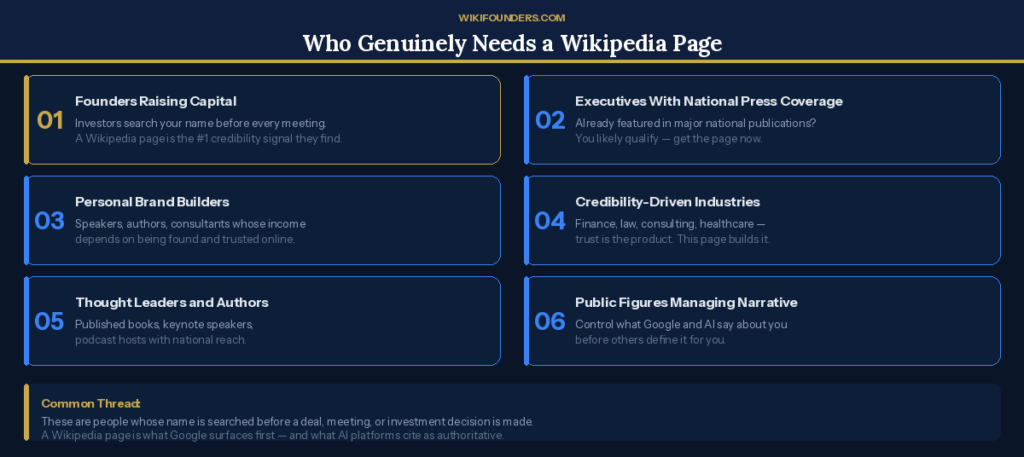
Founders actively raising capital. Investors conduct online due diligence before every meeting without exception. A founder with a Wikipedia page signals something a LinkedIn profile simply cannot: independent, third-party recognition from sources that have no incentive to promote you. Several WikiFounders clients have reported inbound investor inquiries that specifically mentioned finding their Wikipedia page as the credibility signal that prompted outreach. When you are asking someone to write a cheque for your company, the absence of a Wikipedia page is a gap that sophisticated investors notice and quietly register.
Executives who have already earned significant press coverage. If you have been featured in Forbes, Bloomberg, TechCrunch, the Financial Times, or comparable national publications, you likely already meet Wikipedia’s notability standard. Not having a Wikipedia page at that point means the coverage you worked for and in many cases paid a PR firm to secure is not being converted into the permanent, Google-first credibility signal it could be. A Wikipedia page anchors all of that coverage into one authoritative reference point that does not age out of the search results.
Personal brand builders and thought leaders. Speakers, authors, podcast hosts, and consultants whose income depends on being discovered and trusted have a direct financial stake in their Google presence. A Wikipedia page is the foundation that makes every other piece of content you produce more credible. When someone reads an article you wrote, searches your name, and finds a Wikipedia page as the first result, your authority is confirmed before they have read a single word you wrote.
Founders in industries where credibility determines the sale. In finance, legal services, consulting, real estate, and healthcare, the question every client or partner is quietly asking before they engage you is: can I trust this person? A Wikipedia page answers that question before you are ever in the room.
Public figures managing their narrative. If you have received significant media coverage including any coverage that involves contested or negative information a Wikipedia page creates an authoritative presence in your own name that is governed by editorial standards. Without it, the top results for your name are determined entirely by what others have published, with no stable reference point to anchor the narrative.
Who Should Wait And Why
An honest answer requires acknowledging that not everyone is in a position to benefit from a Wikipedia page right now. This is the section most Wikipedia services skip. It is also one of the most important sections in this guide.
Early-stage founders with limited independent media coverage. If your press coverage consists primarily of local news mentions, product launch announcements, or articles your PR team arranged through press releases, you likely do not yet meet Wikipedia’s notability standard. Attempting to create a page before you qualify results in deletion and that deletion record is permanent. It makes every future attempt significantly harder. The right move is to build your independent media coverage first, then pursue a Wikipedia page from a position of genuine eligibility.
Professionals whose reputation is built entirely through private relationships. If you are an executive whose work is internal and whose credibility is built through private networks rather than public visibility, a Wikipedia page may not move any meaningful needle for you. The value of Wikipedia is in public discoverability. If your audience is not searching for you online, the return is limited.
Founders at the very earliest stages. If you are pre-product, pre-revenue, and pre-press, a Wikipedia page is not the right investment right now. Build the business. The coverage will follow, and the Wikipedia page will be there when you genuinely need it and qualify for it.
The AI Citation Argument Nobody Is Talking About Clearly
The case for a Wikipedia page has grown substantially stronger over the past two years for a reason that simply did not exist before: AI search.
When someone asks ChatGPT, Perplexity, Gemini, or Grok about you, those platforms pull from Wikipedia as a primary source. This is not speculation. It is how these systems are built. Wikipedia is one of the most structured, consistently maintained, and editorially verified knowledge sources on the internet which is exactly what large language models prioritize when constructing factual answers about real people and organizations.
If you do not have a Wikipedia page, AI platforms either have nothing authoritative to draw from, or they surface whatever happens to be available which may be incomplete, outdated, or assembled from less credible sources in ways you have no visibility into.
In 2026, the people who matter most to your business investors, journalists, potential clients, board members are increasingly conducting initial research through AI tools, not just through Google. A Wikipedia page ensures that when an AI platform is asked about you, the answer it provides is accurate, credible, and representative of what you have actually built.
Your Wikipedia page is the data layer that determines how AI platforms represent you to the world. That is not a marketing statement. That is how these systems work.
What Google’s Knowledge Panel Has to Do With It
When you search for a person or organization on Google, you may notice an information box appears on the right side of the results page. This is Google’s Knowledge Panel and Wikipedia is the primary source Google uses to populate it.
A Knowledge Panel showing your name, role, organization, and key facts creates immediate visual authority at the top of Google results. It tells anyone searching for you that Google itself recognizes you as a notable entity worth summarizing.
Without a Wikipedia page, your Knowledge Panel may be incomplete, absent entirely, or populated with inaccurate data from less reliable sources that Google has scraped from across the web. You have no way to influence what goes there unless you have a Wikipedia page providing a clean, verified source that Google can draw from.
For founders who interact regularly with investors, media, or enterprise clients, a complete and accurate Knowledge Panel is a meaningful credibility signal that most people notice even without consciously registering why they notice it.
The Credibility Signal No Other Platform Can Replicate
Every credibility signal available to founders and executives has an asterisk and sophisticated audiences know it.
Your LinkedIn profile: you wrote it. Your company website: you own it. Your press releases: your team distributed them. Even media coverage arranged through PR firms carries an asterisk for investors and journalists who understand how the PR industry operates.
Wikipedia carries no asterisk of that kind. It is written by third parties, sourced exclusively from independent publications, governed by editorial standards, and maintained by a community that exists to serve accuracy not to serve you. When a Wikipedia page appears as the first Google result for your name, it signals something no self-published content can replicate: independent sources have verified that your story is worth documenting in an encyclopedia.
That signal compounds over time. Every press article, podcast appearance, and speaking engagement you do after your Wikipedia page is live becomes more credible because there is an authoritative reference point for who you are. Journalists researching you find Wikipedia first. Investors doing due diligence find Wikipedia first. Clients searching your name find Wikipedia first.
Wikipedia vs LinkedIn What Is the Real Difference
This comparison comes up constantly because both platforms are associated with professional credibility. The difference is fundamental and worth being direct about.
LinkedIn is a self-published platform. You created your profile, wrote the content, and chose what to highlight. Sophisticated audiences investors, journalists, enterprise buyers understand this completely. A LinkedIn profile tells them what you want them to know about you. It does not tell them what independent parties have verified about you.
Wikipedia is an editorially governed platform. The content is written by third parties, sourced exclusively from independent publications, and subject to ongoing community review. A Wikipedia page tells a sophisticated audience that the information presented has been verified through independent editorial judgment not constructed by you or your team.
Both matter. LinkedIn is table stakes for professional visibility in 2026. Wikipedia is the credibility anchor that makes everything else you do online more authoritative. They serve fundamentally different functions, and the absence of Wikipedia cannot be compensated for by a stronger LinkedIn presence no matter how complete or well-written your LinkedIn profile is.
What a Wikipedia Page Cannot Do
Setting honest expectations matters. A Wikipedia page is not a solution to every reputation challenge, and treating it as one leads to disappointment.
It will not replace a PR strategy. A Wikipedia page is the output of a strong PR strategy not a substitute for one. Without independent press coverage that meets Wikipedia’s notability standard, there is no Wikipedia page to be had.
It will not fix a serious reputation crisis on its own. If your Google results include significant negative coverage, a Wikipedia page is one tool in a broader reputation management effort not a standalone solution.
It will not give you complete control over your narrative. Because Wikipedia is editorially independent, the content is subject to community editing at all times. You can ensure the page is accurate and well-sourced, but editorial control ultimately belongs to Wikipedia’s volunteer community.
It will not generate leads directly. A Wikipedia page is a credibility signal, not a conversion tool. Its value lies in making every other touchpoint in your sales and marketing process more effective not in directly producing pipeline.
Is a Wikipedia Page Worth the Investment
For founders who qualify and are building a public-facing business, the answer is yes and the reasoning is straightforward.
A Wikipedia page is a one-time investment that compounds indefinitely. It does not expire. It does not require ongoing ad spend. It does not lose relevance the way a press article does. And unlike almost every other investment in your online presence, it becomes more authoritative over time rather than less.
Consider what you are comparing it to. Most founders who are serious about their online presence spend $20,000 to $30,000 on a documentary or a sustained PR campaign. Those investments produce coverage that ranks well for a few months and then gradually moves down the search results. A Wikipedia page takes the output of that investment and converts it into a permanent, first-page Google presence that AI platforms cite for as long as those platforms exist.
WikiFounders packages start at $499 setup plus $99 per month for the Foundation plan, which covers full research, writing, publication support, and basic monitoring. The Authority plan at $749 setup plus $149 per month includes enhanced citation sourcing, full monitoring, and two page edits per month. Every engagement begins with a free notability audit before any payment is required.
At that price point, for a founder who is raising capital, building a personal brand, or operating in a credibility-driven industry, the question is not whether a Wikipedia page is worth it. The question is why you have waited this long to get one.
How WikiFounders Can Help
WikiFounders specializes exclusively in Wikipedia page creation, monitoring, and maintenance for founders, executives, and public figures. This is not one service among twenty it is the only thing we do, which is why our results are consistently stronger than general digital agencies or freelancers who treat Wikipedia as a side project.
Every engagement begins with a free notability audit an honest, professional assessment of your current eligibility before any work or payment begins. If the audit shows you do not yet qualify, we tell you exactly that and explain what coverage you need before proceeding. We do not take on clients who are not ready, because a failed Wikipedia submission hurts everyone.
If you qualify now, the process moves directly to research, drafting, submission, and editorial management with a standard timeline of six to eight weeks to a live, published page.
If you are not yet at the notability threshold, WikiFounders identifies exactly what coverage you need and, through the PR Citation Boost service, actively works to build that coverage before your submission.
View packages at wikifounders.com/pricing or book a free notability audit at wikifounders.com/contact.