
Getting a Wikipedia page is one of the highest-impact steps a founder, executive, or public figure can take for their long-term online presence. A Wikipedia page appears on the first page of Google for almost every name search. It is cited by ChatGPT, Perplexity, and Gemini as a primary authority source. And unlike press coverage that gets buried over time, a Wikipedia page is permanent.
But getting one is significantly harder than most people expect and one wrong move early in the process can permanently damage your chances of ever getting one.
This guide covers everything: what qualifies you, how the process actually works, what mistakes to avoid, and exactly what to do if you are not eligible yet.
What It Actually Means to Get a Wikipedia Page
Most people imagine a simple process write something about yourself, submit it, and it appears. The reality is quite different.
Wikipedia is not a directory, a business listing, or a place to publish your accomplishments. It is an encyclopedia, operated under strict editorial standards maintained by thousands of volunteer editors who have full authority to approve, reject, or delete any article at any time.
Getting a Wikipedia page means convincing those volunteer editors through verifiable, independent, third-party evidence that you or your company is notable enough to deserve a permanent encyclopedic entry. The process is not about writing well. It is about having enough documented public presence that Wikipedia’s editorial community agrees your existence belongs in an encyclopedia.
That distinction matters enormously before you take a single step.
The One Thing That Determines Everything Notability
If there is one concept you must understand before taking any step toward getting a Wikipedia page, it is notability.
Wikipedia defines a topic as notable if it has received significant coverage in reliable sources that are independent of the subject. This definition has three parts and all three must be satisfied simultaneously.
Significant coverage means more than a mention. An article that lists your name among ten other executives does not count. The coverage must address you directly, in detail, as the primary subject of the piece not as a passing reference.
Reliable sources means publications with a genuine editorial process, a track record of accuracy, and independent fact-checking. This includes national newspapers, major industry publications, academic journals, and well-known magazines. It does not include press releases, company blogs, personal websites, social media profiles, or anything your own team wrote or paid for.
Independent of the subject means the source has zero connection to you. An article you wrote yourself does not count. Coverage your PR firm placed as a paid feature does not count. The source must have covered you entirely on its own editorial judgment, with no involvement from your side.
Notability is the single deciding factor Wikipedia editors use to determine whether a page deserves to exist. An article that fails notability will be deleted and that deletion creates a serious, permanent problem for every future attempt.
Who Qualifies for a Wikipedia Page
This is the honest question most people are actually asking when they search “can I create a Wikipedia page for myself” or “who gets a Wikipedia page.”
People who typically qualify:
Founders and executives who have been featured not just mentioned in outlets like Forbes, Bloomberg, TechCrunch, the Financial Times, or comparable national publications in their region. Recipients of major industry awards that have been independently reported in credible media. Authors of books published by recognized publishers and reviewed by credible outlets. CEOs of publicly traded or widely covered companies. Public figures who have been the subject of documented achievement or controversy reported by credible, independent media.
People who often do not qualify yet:
Founders of early-stage startups with limited or only local press coverage. Professionals whose coverage consists entirely of press releases or sponsored content. Executives who appear in roundup articles but have never been the primary subject of an independent feature. Anyone whose only coverage comes from sources their own team initiated or paid for.
The practical benchmark:
Most Wikipedia editors look for three to five substantial, journalist-authored features about you specifically, published in recognized national or major industry outlets, completely independent of anything you or your team arranged or paid for. This is not a guaranteed formula but it is the realistic minimum.
The most important rule before you proceed:
Do not attempt to create a Wikipedia page before confirming you meet the notability standard. A failed attempt creates a permanent deletion record that makes every future attempt significantly harder. Confirm eligibility first, always.
What Sources Wikipedia Accepts and Rejects
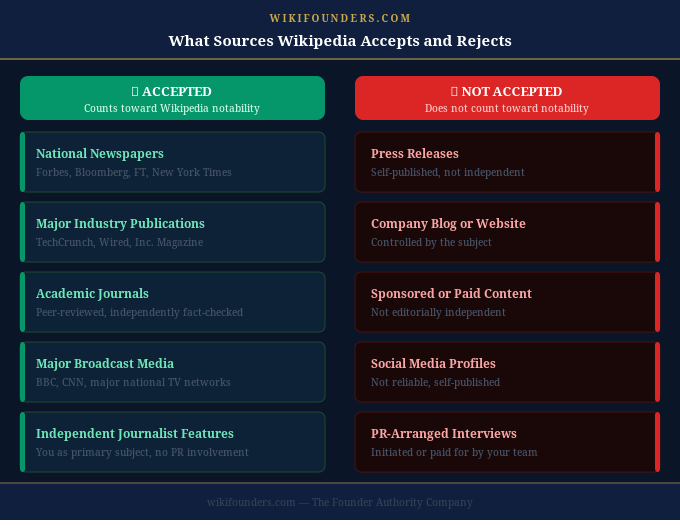
Understanding exactly what counts as an acceptable source is where most Wikipedia attempts break down including many that are made with professional help.
Wikipedia accepts:
National newspapers, reputable business and industry publications with genuine editorial standards, academic journals, books from recognized publishers, and major broadcast media. The defining characteristic is that these organizations have an established editorial process, a reputation for accuracy, and complete independence from the subject.
Wikipedia does not accept:
Press releases you issued, your company website or blog, sponsored content or paid media placements, social media posts regardless of follower count, interviews you arranged yourself, or articles that republish your press release automatically. Wikipedia editors recognize mass press release distribution immediately and dismiss every republished pickup as non-independent.
The practical test:
For any piece of coverage you are considering, ask yourself honestly would a journalist at that publication have written about you if your PR team had never reached out? If the honest answer is yes, it is likely to count. If the article exists because you or your team initiated and facilitated it, it almost certainly will not.
Why You Should Never Try This Yourself First
This section will save you significant time and possibly your Wikipedia eligibility entirely.
Wikipedia tracks every account that creates or edits pages. When an article is submitted and then deleted for failing notability standards, that deletion is permanently logged in Wikipedia’s public records. Any editor reviewing a future attempt for the same subject will find that deletion record immediately and apply significantly greater scrutiny to everything that follows.
The failure rate for self-created Wikipedia pages about individuals is extremely high. Most are deleted within days, sometimes within hours. Editors who delete them often add detailed notes to the deletion log explaining exactly why the subject failed to meet standards notes that every subsequent editor will read before reviewing any future submission.
Beyond the deletion risk, Wikipedia’s conflict of interest policy explicitly discourages creating or editing content about yourself. Pages created in obvious violation of this policy face faster deletion and can flag the subject as a problematic case, making professional assistance harder to execute even later on.
The correct sequence is:
Build your eligibility first. Accumulate genuine independent media coverage. Confirm you meet notability standards through a professional audit. Only then pursue page creation through proper channels with expert guidance.
How to Get a Wikipedia Page Step by Step
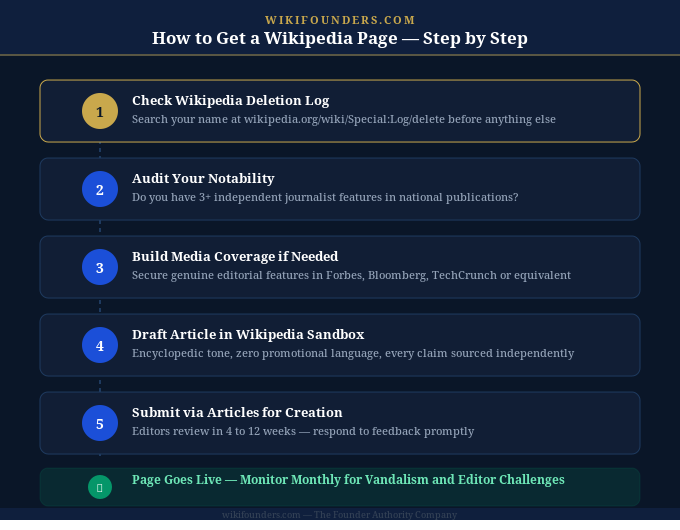
Step 1 Check for existing deletion records
Before anything else, go to Wikipedia’s public deletion log and search your exact name. If a page was previously created about you and then deleted, you are not starting from scratch you are working against a documented history of rejection. In that case the process is fundamentally different: you need to submit a page restoration request rather than create a new article. Skipping this check is one of the most common and most costly early mistakes.
Step 2 Audit your notability honestly
Gather every piece of media coverage you have ever received. Apply the standard strictly only count coverage in recognized publications that is independent, detailed, and focused on you as the primary subject. Be completely honest about whether you currently meet the three-to-five substantial features benchmark. A free notability audit from WikiFounders gives you a definitive, professional answer within 48 hours.
Step 3 Build your media coverage if needed
For most founders who do not yet have a Wikipedia page, insufficient independent press coverage is the missing ingredient. This means working with a PR professional to secure genuine editorial coverage not paid placements or press release distribution, but actual journalist-authored features in credible publications. WikiFounders’ PR Citation Boost service sources new press citations specifically designed to strengthen notability and support a successful Wikipedia submission.
Step 4 Draft the article in a Wikipedia sandbox
Every Wikipedia account comes with a private sandbox a draft space where you write and refine an article before it goes live. The article must be written in encyclopedic tone with absolutely no promotional language. No adjectives about your qualities, no superlatives, no marketing language of any kind. Every claim must be sourced to a credible independent publication. Keep the initial draft focused and concise shorter, well-sourced articles face significantly less editorial resistance than long articles that give reviewers more content to challenge.
Step 5 Submit through Articles for Creation
New articles go through Wikipedia’s Articles for Creation process, where experienced editors review the draft and make an approval decision. This process takes anywhere from four weeks to several months depending on editor availability and the strength of the submission. Editors may return the article with requests for additional sourcing or rewrites this is completely normal and is not a rejection. Responding constructively and promptly to every piece of feedback significantly improves approval rates.
Step 6 Monitor and maintain the page after publication
A Wikipedia page that goes live is a living document that anyone can edit at any time. Without ongoing monitoring, vandalism, inaccurate information, or unauthorized changes can appear on your page and remain there for extended periods showing up in Google search results, Google Knowledge Panels, and AI-generated summaries every time someone searches your name. Active maintenance also means updating the page as your career evolves and adding new citations from recent coverage to keep your notability well-supported over time.
How Long Does It Take
The honest timeline depends entirely on where you are starting from.
If you already meet notability standards: The drafting and submission process typically takes two to four weeks. The Articles for Creation review period takes four to twelve weeks after submission. The total timeline from first step to live page is usually three to six months. WikiFounders’ standard timeline for qualifying clients is six to eight weeks from engagement to a live, published page.
If you need to build media coverage first: Securing genuine editorial features in credible publications typically takes three to six months of consistent, focused PR effort before you have enough to support a credible Wikipedia submission. Total timeline including submission and review is typically nine to twelve months from starting point to live page.
If you have a prior deletion record: Overcoming a deletion history requires significantly stronger notability evidence than the original submission provided. Build your media coverage substantially before attempting again, and work with professional guidance rather than submitting independently a second time.
What Happens After Your Page Goes Live
Getting the page published is the beginning, not the end and this is where most people who manage the process themselves get into trouble.
Vandalism is real and common. Any registered Wikipedia user can edit your page at any time. Without regular monitoring, false information, competitor edits, or malicious changes can appear on your page and remain there for weeks showing up in Google searches, Google Knowledge Panels, and AI-generated answers about who you are and what you have built.
Editorial challenges can arise at any time. Wikipedia editors may challenge a page’s continued existence if they believe notability standards are no longer adequately met or if the sourcing weakens. Active management updating the page as your career evolves, adding new citations from recent media coverage, and responding professionally to editor challenges on the Talk page is what keeps a page stable and authoritative over the long term.
AI platforms pull from Wikipedia constantly. Every time someone asks ChatGPT, Perplexity, or Gemini about you, those platforms reference your Wikipedia page as a primary source. An outdated, vandalized, or poorly maintained page does not just look bad in Google it actively shapes how AI platforms describe you to investors, journalists, and potential clients.
WikiFounders provides monthly monitoring and vandalism protection as part of every ongoing plan, ensuring your page remains accurate and protected long after publication.
How WikiFounders Can Help
WikiFounders specializes exclusively in Wikipedia page creation, monitoring, and maintenance for founders, executives, and public figures. This is not one of twenty services it is the only thing we do, which is why our results are consistently stronger than general digital agencies or freelancers who treat Wikipedia as a side offering.
Every engagement begins with a free notability audit an honest, professional assessment of your current eligibility before any work or payment begins. If the audit shows you do not yet qualify, we tell you exactly that and explain precisely what coverage you need before proceeding. We do not take on clients who are not ready, because failed submissions hurt everyone.
If you qualify now, the process moves directly to research, drafting, submission, and editorial management with a standard timeline of six to eight weeks to a live page.
If you are not yet at the notability threshold, WikiFounders identifies exactly what coverage you need and, through the PR Citation Boost service, actively works to build that coverage before your submission.
View packages at wikifounders.com/pricing orbook a free notability audit at wikifounders.com/contact no obligation, no sales pressure, just an honest assessment of where you stand and what your path to a Wikipedia page looks like.
Frequently Asked Questions
No. Wikipedia requires that a subject meet its notability standard — significant coverage in reliable, independent sources. Not everyone qualifies. Founders, executives, authors, and public figures with documented national media coverage are in the best position to get a Wikipedia page approved and maintained.
The practical test is whether you have three or more substantial journalist-authored features about you specifically, in recognized national or major industry outlets, completely independent of anything you or your team arranged or paid for. A free notability audit from WikiFounders gives you a definitive professional answer within 48 hours.
Technically yes, but Wikipedia’s conflict of interest policy strongly discourages it and self-created pages have a very high deletion rate. More critically, a failed attempt creates a permanent deletion record that makes every future attempt significantly harder. Working with a professional service for the initial submission is strongly recommended.
For subjects who already meet notability standards, the Articles for Creation review takes 4 to 12 weeks after submission. Total timeline from starting work to a live page is typically 3 to 6 months. WikiFounders’ standard timeline for qualifying clients is 6 to 8 weeks from engagement to live page.
Wikipedia accepts national newspapers, major business and industry publications, academic journals, and major broadcast outlets. It rejects press releases, company blogs, sponsored content, social media, and paid placements. The coverage must be completely independent — your team must have had no involvement in initiating or funding it.
A deletion creates a permanent log entry on Wikipedia. Any future attempt is reviewed against that record with greater scrutiny. You cannot simply recreate the page — you must submit a formal restoration request with significantly stronger notability evidence than the original submission provided.
Yes, significantly. Wikipedia pages consistently appear on the first page of Google for name searches. They feed directly into Google’s Knowledge Panel and are cited as primary sources by ChatGPT, Perplexity, Gemini, and Grok. It is the single most impactful credibility signal available in search results today.
WikiFounders packages start at $499 setup plus $99 per month for the Foundation plan, covering full research, writing, publication support, and basic monitoring. The Authority plan at $749 setup plus $149 per month includes enhanced sourcing, full monitoring, and two page edits per month. A free notability audit is included before any paid engagement begins.
Build your media coverage before attempting a submission. WikiFounders’ PR Citation Boost service actively sources new independent press coverage to strengthen your notability profile. Most founders who are not yet eligible reach the threshold within 3 to 6 months of focused, targeted PR work.
Yes. Wikipedia’s conflict of interest policy discourages subjects from creating pages about themselves but does not prevent third parties from doing so — provided the paid relationship is disclosed per Wikipedia’s terms of service and the article meets all standard guidelines. This is precisely how professional Wikipedia services like WikiFounders operate.