
⚡ Quick Answer
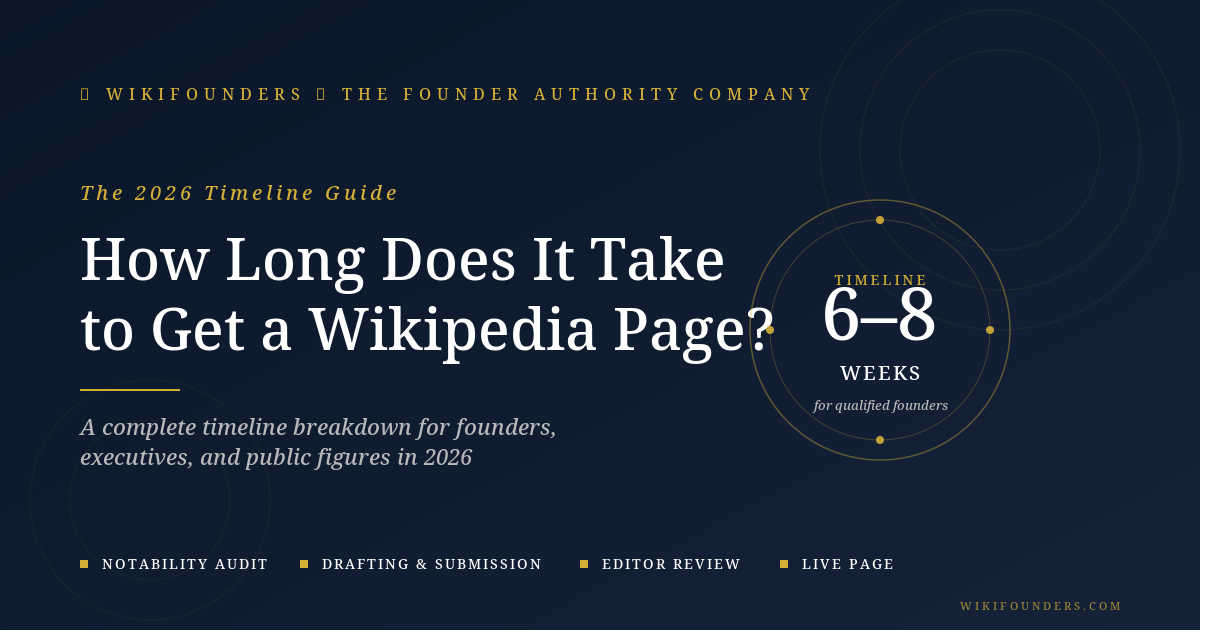
For founders who already meet Wikipedia’s notability standard, the realistic timeline from first step to a live page is 3 to 6 months with the Articles for Creation review alone taking 4 to 12 weeks. WikiFounders manages the full process in 6 to 8 weeks for qualifying clients. If you do not yet meet the notability standard, add 3 to 6 months of PR work before submission. If you have a prior deletion record, the timeline extends further and requires a different approach entirely.
If you are planning to raise capital, build a public profile, or simply want to know what you are committing to before starting, the timeline question is the right one to ask first.
Most articles about Wikipedia skip it entirely or bury the answer under generic advice about notability and sourcing. This guide answers it directly with a breakdown of every scenario, every factor that affects the timeline, and the honest truth about what can go wrong.
Why Getting a Wikipedia Page Takes as Long as It Does
The first thing to understand is that Wikipedia is not a publishing platform with a customer service team. It is an encyclopedia governed entirely by volunteer editors unpaid community members who review, approve, reject, and manage articles in their spare time.
As of 2026, the English version of Wikipedia has approximately 910 active volunteer moderators overseeing more than 6.7 million articles. On any given day, around 450 new articles are submitted for review. For those 910 volunteers to process every article in a single day, each would need to review more than 7,000 pieces of content. That is not possible and the backlog is the direct result.
This is not a system designed around your timeline. It is a system designed around editorial quality, and the pace reflects that priority. Understanding this upfront prevents the frustration that comes from treating Wikipedia like a service with a predictable delivery date.
Beyond the backlog, approval speed is also affected by the quality of your submission, the strength of your sourcing, and most importantly whether you actually meet Wikipedia’s notability standard before you submit. The majority of delays and rejections are caused by submissions that were not ready. Getting the preparation right before submission is the single most important investment in your timeline.
The Three Timelines Which One Applies to You
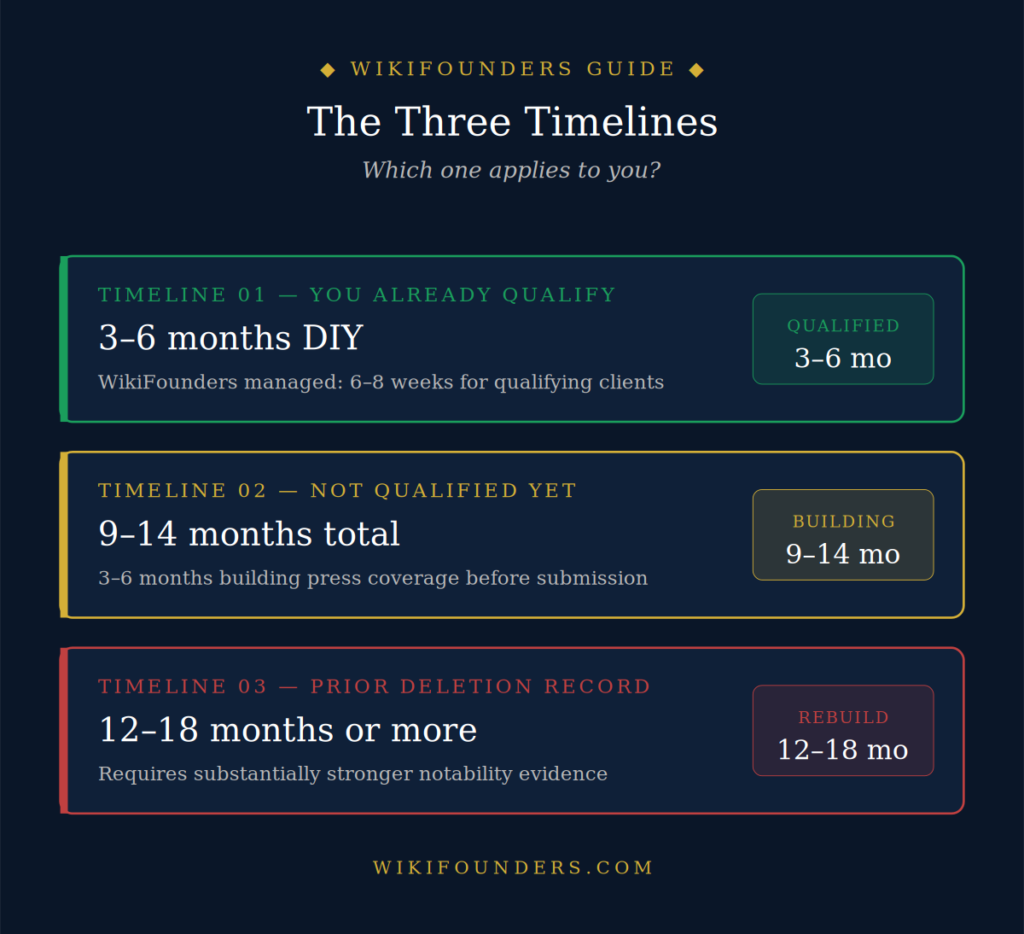
There is no single answer to how long it takes to get a Wikipedia page because the starting point is different for every person. Three distinct scenarios determine your actual timeline, and knowing which one applies to you is the most important thing you can do before taking any action.
Timeline 1 applies if you already meet Wikipedia’s notability standard meaning you have significant, independent, journalist-authored coverage in recognized national or major industry publications, with no prior deletion record.
Timeline 2 applies if you do not yet meet the notability standard meaning your press coverage is insufficient, too local, or consists largely of PR-arranged or paid placements that Wikipedia editors will not count.
Timeline 3 applies if a Wikipedia page about you was previously created and then deleted meaning there is a permanent deletion record that every future editor will review before considering any new submission.
Each scenario has a fundamentally different timeline, a different process, and a different set of risks. Choosing the wrong path particularly submitting before you are ready does not just delay your page. It can permanently damage your chances.
Timeline 1 You Already Qualify
This is the most straightforward scenario and the one WikiFounders works with directly from day one.
Week 1 to 2 Research and preparation. The process begins with a thorough audit of your existing media coverage identifying every qualifying source, confirming its independence, and building the citation foundation the article will rest on. This phase also includes checking Wikipedia’s deletion log for any prior submissions under your name and researching related Wikipedia articles to understand how editors in your niche typically approach similar subjects.
Week 2 to 4 Drafting. The article is written in encyclopedic tone neutral, sourced, and structured according to Wikipedia’s manual of style. Every factual claim is attributed to an independent, verifiable source. No promotional language. No superlatives. No first-person voice. The draft is refined in a Wikipedia sandbox until it is submission-ready.
Week 4 Submission via Articles for Creation. The article is submitted through Wikipedia’s Articles for Creation process, where it enters the review queue managed by volunteer editors.
Week 4 to 16 Review period. This is the phase you cannot fully control. The Articles for Creation review typically takes 4 to 12 weeks depending on editor availability and the volume of submissions in the queue. During this period, editors may return the article with requests for additional sourcing, tone adjustments, or structural changes. Each round of feedback requires a response and resubmission, which adds time.
Total realistic timeline 3 to 6 months from first step to live page.
WikiFounders’ managed timeline for qualifying clients is 6 to 8 weeks from engagement to a live, published page. This compression comes from two things: deep experience with what Wikipedia editors are currently prioritizing, and the ability to respond to editorial feedback quickly and professionally.
Timeline 2 You Do Not Qualify Yet
This is the most common scenario and the one that catches the most people off guard.
If your press coverage does not meet Wikipedia’s notability standard, there is no shortcut. Submitting anyway results in deletion, and that deletion becomes a permanent part of your Wikipedia record that every future editor will see. The path forward requires building your notability before attempting a submission not after a failed one.
Phase 1 Building media coverage: 3 to 6 months. This means securing genuine, journalist-authored features about you specifically, in recognized national or major industry publications, with no involvement from your PR team in the editorial decision. Three to five substantial features is the practical minimum. This work cannot be rushed it requires consistent PR effort over months, not weeks.
Phase 2 Research, drafting, and submission: 4 to 6 weeks. Once your coverage is strong enough, the process follows the same path as Timeline 1.
Phase 3 Articles for Creation review: 4 to 12 weeks. Same as Timeline 1.
Total realistic timeline 9 to 14 months from starting point to live page.
The most important thing to do right now if you are in this scenario is to start building your coverage immediately not to attempt a Wikipedia submission. Every month you spend building genuine independent coverage is a month closer to a page that will actually survive. WikiFounders’ PR Citation Boost service sources new press citations specifically designed to meet Wikipedia’s notability standard, with a typical coverage-building timeline of 3 to 6 months before submission.
Timeline 3 You Have a Prior Deletion Record
This is the most misunderstood scenario and the most dangerous one to approach without professional guidance.
When a Wikipedia page is created and then deleted, the deletion is permanently logged in Wikipedia’s public records. Any editor reviewing a future submission for the same subject will find that record immediately. The notes left by the deleting editor explaining exactly why the page failed are visible to every reviewer who follows.
A prior deletion does not make a new page impossible. But it raises the bar significantly and changes the approach entirely.
Step 1 Understand why the deletion happened. Before anything else, the deletion log must be reviewed carefully to understand the specific reasons the page was removed. This determines what needs to change before any future attempt.
Step 2 Build substantially stronger notability evidence. A resubmission with the same level of coverage that supported the original attempt will almost certainly be deleted again. The notability evidence must be meaningfully stronger typically more coverage, more recent coverage, and coverage from higher-authority publications than the original submission relied on.
Step 3 Consider a formal restoration request. In some cases, rather than creating a new page, a formal page restoration request is the more appropriate path. This process requires demonstrating that circumstances have changed materially since the deletion.
Total realistic timeline 12 to 18 months or more, depending on the original deletion reason.
If you have a prior deletion record and are considering another attempt, a professional notability audit before taking any action is not optional it is essential. An unsuccessful second submission under a deletion record can permanently close the door on future attempts.
What Slows Down Your Wikipedia Approval
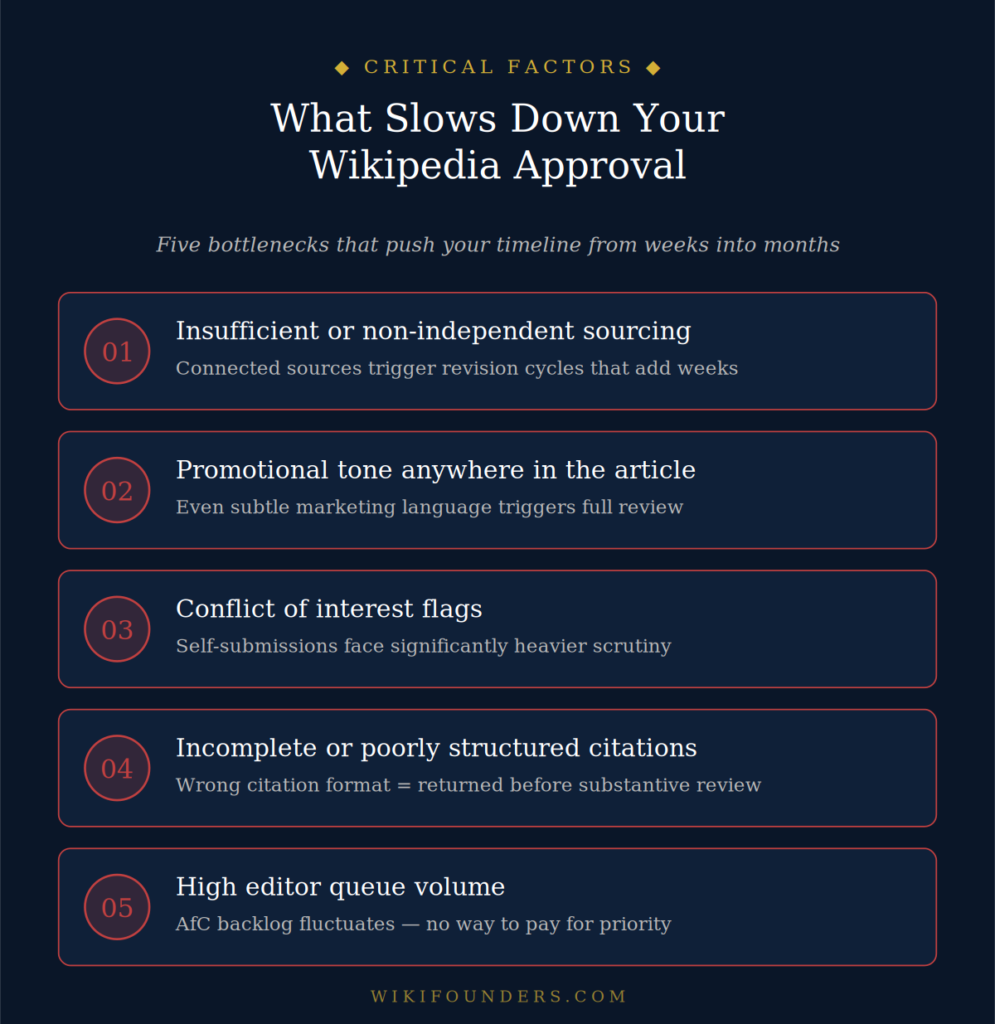
Understanding what causes delays is as valuable as understanding the timeline itself. These are the most common reasons Wikipedia approval takes longer than expected or fails entirely.
Insufficient or non-independent sourcing. This is the single most common cause of rejection and delay. If the sources cited in your article do not meet Wikipedia’s reliability standard or if they are connected to you in any way editors will return the article for revision. Every revision cycle adds weeks to your timeline.
Promotional tone anywhere in the article. Wikipedia editors are exceptionally good at identifying promotional language, even when it is subtle. A single sentence that reads as self-promotion can trigger a full review and rewrite request. The standard is strictly encyclopedic not positive, not favorable, not brand-safe. Strictly neutral.
Conflict of interest flags. If the submission is associated with an account that has edited similar pages, has a username resembling the subject, or has a history of promotional contributions, editors will scrutinize the submission significantly more carefully. This is one of the primary reasons self-submissions fail at a much higher rate than third-party submissions.
Incomplete or poorly structured citations. Wikipedia has a specific citation format. Articles with incomplete, inconsistently formatted, or poorly sourced citations are returned for correction before substantive review even begins.
High editor queue volume. The Articles for Creation backlog fluctuates. During periods of high submission volume which tend to correlate with Google algorithm updates and increased public interest in online reputation review times extend. There is no way to expedite your position in the queue through payment or priority requests.
What Speeds Up Your Wikipedia Approval
While you cannot control the review queue, several factors within your control meaningfully improve both the speed and success rate of your submission.
Submitting only when you genuinely qualify. The fastest path through the Wikipedia process is a strong first submission that requires minimal revision. Every round of back-and-forth with editors adds weeks. Getting the preparation right before submitting not after the first rejection is the most reliable way to compress the timeline.
Writing to Wikipedia’s standards from the first draft. Articles that arrive in the review queue in proper encyclopedic format, with complete citations in the correct style, move through review faster than articles that require structural corrections before substantive evaluation can begin.
Responding to editor feedback quickly and professionally. When an editor returns your submission with revision requests, the speed of your response matters. Articles that sit in revision for weeks lose momentum in the queue. Responding within 48 to 72 hours with complete, well-considered revisions keeps the process moving.
Building a clean Wikipedia editing history first. Accounts with a positive editing history contributions to existing articles, constructive Talk page interactions, no conflict of interest flags receive more favorable treatment from reviewers than brand new accounts submitting articles about themselves or their clients on their first edit.
Working with a specialized Wikipedia service. The difference between a first-time submission and one from a team with deep familiarity with current editor preferences is significant. WikiFounders’ 6 to 8 week timeline for qualifying clients is not an accident it reflects years of experience building submissions that align with what Wikipedia editors are currently approving.
What to Do While You Wait
The Articles for Creation review period is not a passive waiting game. How you use this time directly affects both the outcome and your preparedness for what comes next.
Monitor the Talk page regularly. Wikipedia editors communicate through the article’s Talk page. Checking it every few days ensures you do not miss feedback, revision requests, or editorial questions that require a response. Delayed responses slow the process and can signal disengagement to reviewers.
Do not edit the submitted article impulsively. One of the most common mistakes during the review period is making frequent, minor edits to the submitted draft while it is under review. This can trigger additional scrutiny and signal to editors that the article is not stable. Make edits only in response to specific editor feedback not out of anxiety about the wait.
Continue building your media coverage. New, high-quality press coverage published during the review period strengthens your notability profile. If an editor requests additional sourcing, having recent features to cite can be the difference between approval and rejection on the revision round.
Prepare for post-publication monitoring. Use the review period to set up monitoring systems for your page once it goes live. A Wikipedia page that goes unmonitored after publication is vulnerable to vandalism, inaccurate edits, and editorial challenges that can accumulate undetected over weeks.
What Happens After Your Page Goes Live
Approval is not the finish line. It is the beginning of a new phase that most people are completely unprepared for.
Vandalism is real and immediate. From the moment your page goes live, any registered Wikipedia user can edit it. Vandalism ranging from minor inaccuracies to significant false information can appear within hours of publication. Without active monitoring, these edits accumulate and show up in Google results, Google Knowledge Panels, and AI-generated summaries about you.
Editorial challenges can arise at any time. Wikipedia editors may challenge the continued existence of your page if they believe notability standards are no longer adequately met particularly if the sourcing is thin or has not been updated as your career has evolved. Active management adding new citations from recent coverage, responding to Talk page challenges professionally, and keeping the article current is what keeps a page stable over the long term.
AI platforms update their data over time. ChatGPT, Perplexity, Gemini, and Grok all draw from Wikipedia as a primary source. An outdated or inaccurate Wikipedia page does not just look bad in Google it actively shapes how AI platforms describe you to investors, journalists, and potential clients every time someone asks about you.
WikiFounders provides monthly monitoring and vandalism protection as part of every ongoing plan, ensuring your page remains accurate and protected long after publication.
How WikiFounders Compresses the Timeline
For founders and executives who qualify, WikiFounders’ standard timeline from engagement to a live page is 6 to 8 weeks. This is significantly faster than the industry average for several specific reasons.
Every engagement begins with a free notability audit a professional assessment of your current eligibility that takes 48 hours and confirms whether you qualify before any work or payment begins. If you do not qualify, we tell you exactly that and explain what coverage you need. We do not take on clients who are not ready.
For qualifying clients, the research, drafting, and submission process is handled entirely by our team with deep familiarity with current Wikipedia editorial standards, active AfC reviewer preferences, and the specific sourcing patterns that accelerate approval.
For clients who are not yet at the notability threshold, the PR Citation Boost service actively works to build the independent press coverage needed before submission with a typical coverage-building timeline of 3 to 6 months.
View packages at wikifounders.com/pricing or book a free notability audit at wikifounders.com/contact.
Frequently Asked Questions
For founders who already meet Wikipedia’s notability standard, the realistic timeline is 3 to 6 months from first step to a live page, with the Articles for Creation review alone taking 4 to 12 weeks. WikiFounders manages the full process in 6 to 8 weeks for qualifying clients.
Wikipedia is governed entirely by approximately 910 volunteer editors who review more than 450 new article submissions every day in their spare time. There is no paid staff and no priority queue. The backlog is the direct result of this model and the pace reflects editorial quality standards, not inefficiency.
The Articles for Creation review typically takes 4 to 12 weeks after submission, depending on editor availability and current queue volume. Editors may return the article with revision requests, and each revision round adds additional time. Strong, well-sourced submissions move through the queue faster than those requiring multiple correction cycles.
The page will be deleted and that deletion creates a permanent log entry on Wikipedia’s public deletion record. Every future editor reviewing a subsequent submission will find that record and apply significantly greater scrutiny. Submitting before you qualify does not just fail it actively damages your future chances.
You cannot pay to expedite your position in the review queue. However, submitting only when you genuinely qualify, writing to Wikipedia’s exact standards from the first draft, and responding to editor feedback within 48 to 72 hours all meaningfully improve both speed and approval rate. Working with an experienced Wikipedia service like WikiFounders compresses the timeline significantly.
A prior deletion record extends the timeline to 12 to 18 months or more. The deletion log is permanent and visible to every future reviewer. Resubmission requires substantially stronger notability evidence than the original attempt, and in some cases a formal page restoration request is a better path than creating a new article.
Building the independent press coverage needed to meet Wikipedia’s notability standard typically takes 3 to 6 months of consistent, focused PR work. This means securing genuine journalist-authored features in recognized national or major industry publications not press release distribution or paid placements, which do not count toward notability.
A properly created Wikipedia page with strong notability support is permanent. However, pages without ongoing monitoring are vulnerable to vandalism, editorial challenges, and notability disputes that can result in deletion long after initial approval. Active monthly monitoring is what keeps a page stable and authoritative over the long term.
For founders where time and first-impression credibility matter, yes. A specialized Wikipedia service like WikiFounders handles research, drafting, submission, and editorial management compressing the timeline to 6 to 8 weeks for qualifying clients versus the 3 to 6 month DIY average. Every WikiFounders engagement begins with a free notability audit before any payment is required.
The fastest path is: confirm you genuinely qualify first, build a submission that meets Wikipedia’s standards precisely, and work with a team that has deep familiarity with current editor preferences. Attempting to shortcut the notability requirement is the single biggest cause of failed submissions and extended timelines. WikiFounders’ free notability audit tells you within 48 hours exactly where you stand.